Macro United States
History Doesn't Bite — But It Does Whisper
What a Century of Fed Chair Transitions Tells Us About the Next One
Bull, Bear, Bust · 9 May 2026 · 6 min read
Markets are creatures of pattern. They sniff out the slightest shift in tone, the faintest change in voice. And few shifts are watched more closely than the changing of the guard at the Federal Reserve. There is a persistent whisper on Wall Street that a new Fed Chair brings a "crash" or a "test" for stocks. As we watch the baton pass from Jerome Powell to Kevin Warsh, the question we keep asking ourselves is not "what does the headline say?" but rather "what does the history book say?"
We went back to look. Here is what we found.
KEY POINTS A quick-read snapshot of this newsletter's commentary
▸ A new Fed Chair historically triggers a market "test," not a crash: Barclays finds an average S&P 500 drawdown of about 5% in month one, deepening to 12% within three months and 16% within six. ▸ By year-end the damage is usually minor: the S&P 500 was only down 1.3% at the end of Powell's first year despite 2018's "Volmageddon." ▸ Harvard's Dr. Dejan Kovac finds markets underperform by 7.7 percentage points in a new Chair's first year, but that gap shrinks to a statistically tiny 1.8% once you strip out the surrounding economic conditions — the "Replacement Illusion." ▸ 1987's Black Monday under Greenspan is the exception, not the rule — Burns, Bernanke and Powell each inherited very different, pre-existing problems. ▸ There is typically a "Learning Curve": a noisy testing phase in the first six months while markets work out whether the new Chair is a Hawk or a Dove. ▸ As Kevin Warsh takes the helm from Jerome Powell, we are sitting on 40% cash, positioned to buy the weakness any testing phase creates rather than fearing it. ▸ We are not changing our strategy for the name on the door: short the froth, accumulate the value, hold the cash. |
The "Test" is Real, But Not Always a Crash
The data is clear: markets do tend to put a new Fed Chair through an initiation ritual. But it is rarely the apocalypse that the fear-mongers promise.
Barclays looked at every transition since 1930. They found that after a new Chair takes the seat, the S&P 500 has historically endured an average maximum drop (drawdown) of about 5% in the first month, deepening to 12% within three months, and reaching 16% within the first six months. Let's be honest — that is uncomfortable. It is volatility. But for a long-term investor, a 5% to 16% drawdown is a "correction," not the end of the financial world.
However, here is where we part ways with the doom loop. Looking at cumulative returns (the actual money you would have made or lost), the picture changes. Fisher Investments points out that the numbers look different if you measure the total return of the market at the end of those periods. For example, while Powell faced a "Volmageddon" early in 2018, the S&P 500 was actually only down 1.3% at the end of his first year. The volatility was brutal, but the net damage was minimal.
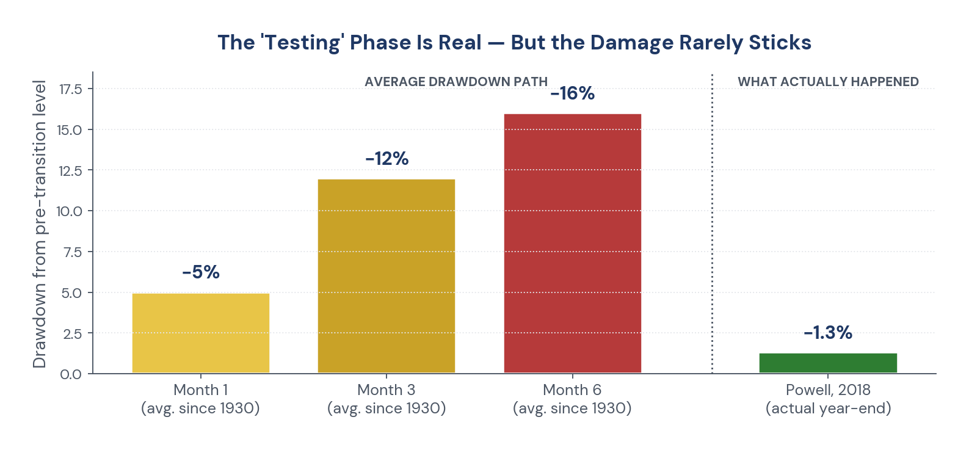
Figure 1. The historical average drawdown path across every Fed Chair transition since 1930 (Barclays), against what actually happened by the end of Jerome Powell's first year.
The "Replacement Illusion" vs. The Real World
We are always skeptical of purely mechanical correlations. Do stocks drop because of the person, or while the person is there?
Dr. Dejan Kovac at Harvard did the math we care about. He found that markets underperform by about 7.7 percentage points in the year following a new Chair. But — and this is a big "but" — once you strip out the surrounding economic conditions (inflation, recession risk, interest rates), that huge gap shrinks to a statistically tiny 1.8%. In other words, the specific human in the chair matters far less than the storm clouds gathering around the chair.
This is the "Replacement Illusion." The new boss usually steps in when the economy is already hot, or when trouble is brewing. They don't cause the weather; they just inherit the forecast.
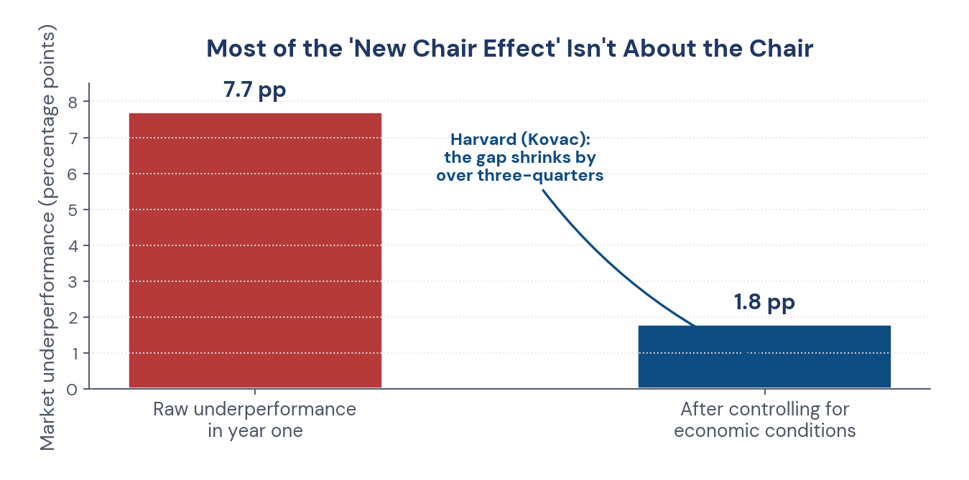
Figure 2. Most of the apparent "new Chair" underperformance disappears once economic conditions are controlled for (Harvard, Dr. Dejan Kovac).
The Greenspan Exception and the "Learning Curve"
The one historical event that keeps traders up at night is the 1987 crash. Greenspan took office in August 1987. Two months later, the market saw Black Monday. It is the most famous "test" in history. But does one data point make a rule? When you look at Burns (inherited a recession), Bernanke (financial crisis took 18 months to boil), and Powell (Covid was two years in), the evidence is mixed.
What seems more universal is the "Learning Curve." According to the data, there is often a "testing" phase in the first six months as the market tries to figure out if the new Sheriff is a Hawk (worried about inflation) or a Dove (worried about jobs). This creates noise. But the market eventually prices in the reality, not the persona.
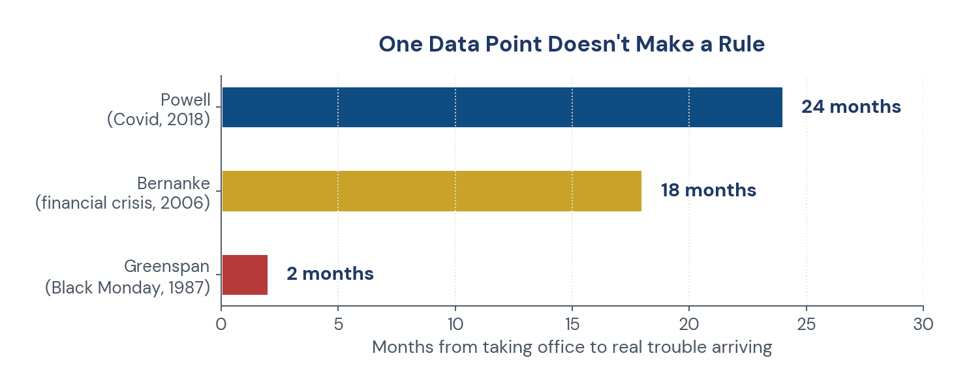
Figure 3. One data point doesn't make a rule — how long real trouble actually took to arrive after three different transitions.
What This Means for Us Right Now (May 2026)
As we write this, Kevin Warsh is preparing to take the helm. We are watching the history books closely because we are currently sitting on 40% cash.
If the historical "testing" phase of 5% to 16% plays out again, we are perfectly positioned. We aren't running from the volatility. We are preparing to buy the weakness that the "testing" phase might create. We are not betting on a crash; we are betting that liquidity and patience will be rewarded when the market realizes the world hasn't ended.
Furthermore, history shows us that the modern market is front-running the playbook. Institutions have already hedged. The drop in gold and the initial volatility we saw on Warsh's nomination was the market placing its bets early. The real movement comes later, when the economic data changes — not just the signature on the podium.
The Bottom Line
We are not changing our strategy because of the name on the office door. We are staying the course. We are short the froth. We are accumulating the value. We are holding the cash.
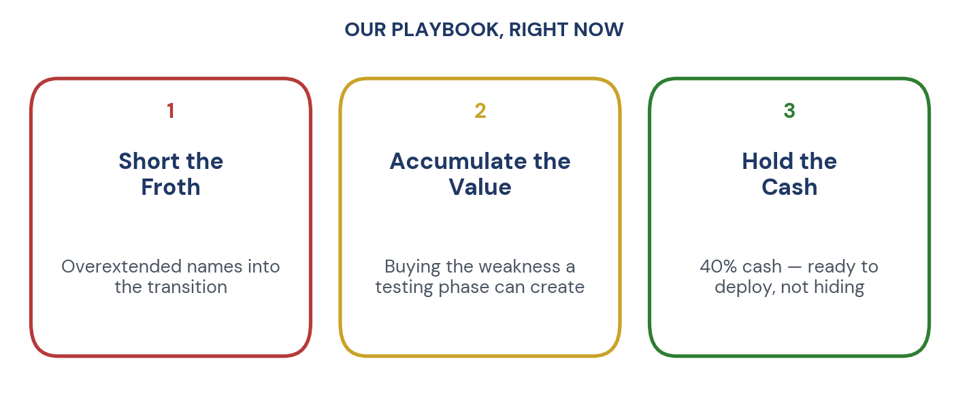
Figure 4. Our playbook right now.
History whispers that there may be turbulence ahead. But we don't fear the turbulence. We have our seatbelts fastened.
DISCLAIMER This newsletter is published for informational and educational purposes only. Nothing contained herein constitutes investment advice, a solicitation, or a recommendation to buy or sell any financial instrument. All investment involves risk, including the loss of principal. Past commentary does not guarantee future results. Any views expressed are those of the author as of the date of publication and are subject to change without notice. Please consult a licensed financial advisor before making any investment decisions. |