Thematics-Sector Spotlight Technology
The Machine and the Mirror
Can AI Really Trade for Us?
Bull, Bear, Bust · 12 May 2026 · 11 min read
Dear Client,
The question arrives in our inbox at least a dozen times a week. "Why don't you just let AI run the portfolio?" "Isn't the whole point of artificial intelligence to take the emotion out of trading?" "Aren't you obsolete?"
Fair questions. Deserving of honest answers.
We have spent the better part of two years watching, testing, and arguing about artificial intelligence in markets. We have talked to quants who run billions on machine learning models. We have talked to Silicon Valley engineers who believe their algorithms will eventually eat every discretionary trader alive. And we have done our own small experiments, feeding our own rules into models to see what comes back.
The conclusion we have reached is uncomfortable for both the AI zealots and the AI skeptics. The truth sits in the messy middle.
Let me explain.
KEY POINTS A quick-read snapshot of this newsletter's commentary
▸ AI genuinely excels at scale: scanning forty thousand stocks across fifty timeframes, testing twenty thousand rule variations in an afternoon, and screening thirty thousand stocks an hour against our three thousand a weekend. ▸ But models trained on 2010–2020 broke when the regime shifted in 2022 — markets are psychology, not physics, and a machine cannot adapt to a world it has never seen. ▸ Hallucination is real and dangerous: the Backtest, Correlation and Narrative Hallucinations all let a machine present a guess as fact. ▸ Real backtests humble the hype — a 200,000-trade Supertrend study held a 40–43% win rate, and a triple moving average crossover hit just 52%, barely better than a coin flip. ▸ We use AI for screening, backtesting and watchlist monitoring — never for the final decision on when to buy, sell, or how much to risk. ▸ The human edge is wisdom: knowing when the rules don't apply, when a correction becomes a crash, and when to sit on cash — we currently hold 40% cash as dry powder, not inefficiency. ▸ We are not afraid of AI and use it every day, but we are not handing it the keys — those stay with us. |
What AI Actually Does Well
Let us give credit where credit is due. There are things AI can do that no human can match.
Pattern recognition at scale. A machine can scan forty thousand stocks across fifty timeframes in the time it takes you to brew your morning coffee. It can identify head and shoulders patterns, Fibonacci retracements, and volume divergences across every market simultaneously. We cannot do that. We do not even pretend to try.
Backtesting without exhaustion. We test our rules on twenty years of data. A machine can test twenty thousand variations of a rule in an afternoon. It can find the optimal moving average length, the perfect RSI threshold, the exact volume confirmation level that would have worked best in the past. That is real. That is valuable.
Execution without hesitation. When a machine sees its signal, it buys or sells in milliseconds. It does not freeze. It does not hope. It does not check its phone for news. It just acts. For high-frequency strategies and tight stop management, this is a genuine advantage.
Screening at impossible scale. We can run a Graham net-net screen on three thousand stocks over a weekend. A machine can do it on thirty thousand stocks every hour. It can find the one Japanese micro-cap trading below net working capital that we would have missed entirely.
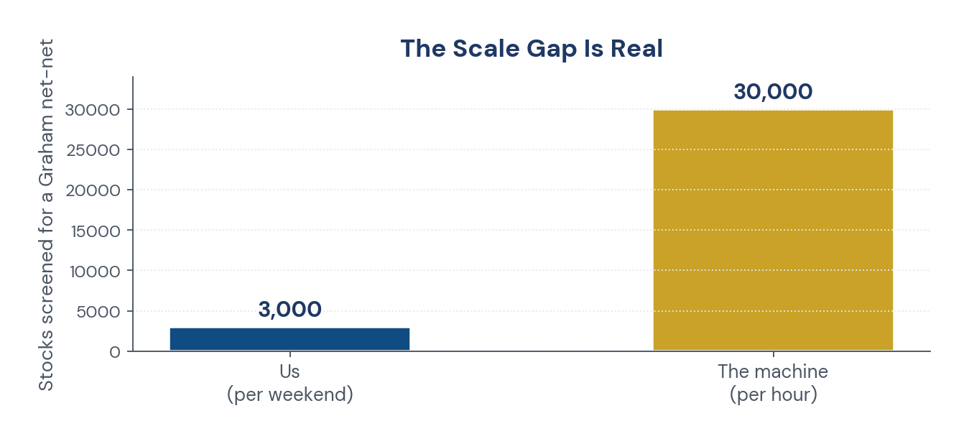
Figure 1. The scale gap between what we can screen by hand and what the machine screens in an hour, for the same Graham net-net filter.
These are not hallucinations. These are real capabilities. We use AI-powered screens ourselves. We would be foolish not to.
Where AI Falls Apart
But here is the part that the salespeople leave out of the brochure.
The market is not a stable system. Machine learning works beautifully when the past resembles the future. When patterns repeat reliably. When relationships hold steady. But markets are not physics. They are psychology. And psychology changes.
A model trained on 2010 to 2020 learned a world of zero interest rates, quantitative easing, and passive buying. That world ended in 2022. The model did not adapt. It broke. We watched quantitative hedge funds blow up that year because their machines had never seen inflation. They thought it was a hallucination. It was not.
AI cannot read the tape like Livermore. A machine can measure volume. It cannot feel the difference between distribution and fear. It can track price. It cannot sense the pause before the plunge. There is a texture to market action that no algorithm has yet learned to parse. Maybe someday. Not today.
Hallucination is real, and it is dangerous. Ask any lawyer who used ChatGPT to write a brief. The AI invented cases. It cited rulings that never existed. It was completely confident and completely wrong.
Now imagine that hallucination applied to your portfolio. The AI sees a cup and handle pattern that does not exist. It backtests a strategy on data that was not actually available at the time. It finds a correlation that is pure noise. And it trades on that noise with your capital. The hallucinations are not bugs. They are features of how these models work. They guess. Sometimes they guess wrong. And they never tell you when they are guessing.
AI has no concept of narrative. The Iran war spiked oil prices. A machine sees the price movement. It does not understand that a wider conflict would close the Strait of Hormuz. It does not know that a new Fed chair brings a testing phase. It has no theory of the world. It only has numbers. When the numbers change because the world changed, the machine is always late.
AI cannot manage risk the way we do. A machine can calculate value at risk. It cannot feel the difference between a seven percent loss in a liquid large-cap and a seven percent loss in a Japanese micro-cap. It cannot decide to hold more cash because the sleeping is better. Risk is not just a number. Risk is the feeling in your gut at two in the morning. AI has no gut.
The Quant Reality Check
The search results confirm what we have seen with our own eyes.
A comprehensive backtest of 200,000 trades on the Supertrend indicator found that win rates remained consistently between 40 and 43 percent across every parameter tested. The AI could optimize the inputs. It could not escape the fundamental reality of that strategy. The machine was not smarter than the math. It was just faster at doing the math.
Another study found that a 7, 31, 103 triple moving average crossover on a one-hour timeframe produced a 52 percent win rate. That is barely better than a coin flip. The AI found the optimal parameters. The optimal parameters still flipped a coin.
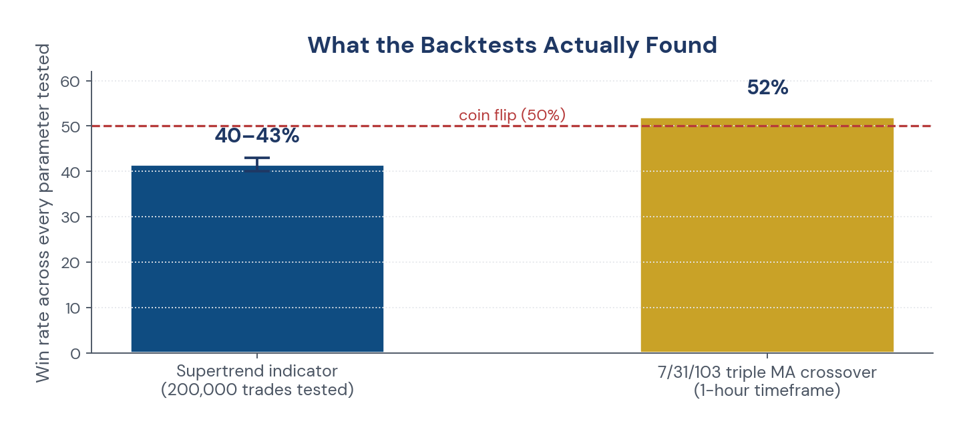
Figure 2. What two real backtests actually found — a 200,000-trade Supertrend study and a triple moving average crossover, against a coin flip.
The QuantConnect community, which lives and breathes algorithmic trading, has documented again and again that the edge in trading is not in finding the perfect indicator. The edge is in execution, position sizing, and risk management. AI can help with the first. It cannot help with the second and third because those require judgment.
What We Actually Use AI For
Let me be transparent about where AI fits into our own process.
We use AI-powered screens to find net-nets. The machine scrapes balance sheets across Japan, Korea, and China faster than we ever could. It flags the companies trading below net working capital. We then do the human work of reading the footnotes, understanding the business, and deciding whether the discount is real or a trap.
We use AI to backtest our rules. When we consider a new filter or a new pattern, we run it through historical data. We want to know how the head and shoulders pattern performed in the 1970s versus the 2010s. The machine gives us that answer in seconds. We then apply our judgment to whether the past predicts the future.
We use AI to monitor our watchlist. The machine alerts us when a stock hits our target entry price. It tracks volume surges. It flags unusual options activity. It is our tireless assistant, not our portfolio manager.
What we do not use AI for is making the final decision. The machine does not decide when to buy. It does not decide when to sell. It does not decide how much to risk. Those decisions belong to us. They belong to a human who has read Reminiscences of a Stock Operator a dozen times and still finds new lessons in it.
The Hallucination Fear Is Real
The term "hallucination" comes from the AI industry itself. It refers to the tendency of large language models to invent facts with absolute confidence.
In trading, the hallucination takes different forms.
The Backtest Hallucination
The AI finds a strategy that would have returned forty percent annually for the past decade. What it does not tell you is that the strategy traded stocks that were not yet liquid, used data that was revised after the fact, or assumed zero slippage. The past performance is a mirage.
The Correlation Hallucination
The AI finds that snowfall in Buffalo predicts the price of gold. The correlation is statistically significant. It is also meaningless. The machine does not know the difference between causation and noise. It finds patterns everywhere. Most of them are accidents.
The Narrative Hallucination
You ask the AI why a stock fell. It invents a reason. It weaves a story about earnings or analyst downgrades or macroeconomic fears. The story sounds plausible. It may even be correct. But the AI does not know. It is guessing. And it presents its guess as fact.
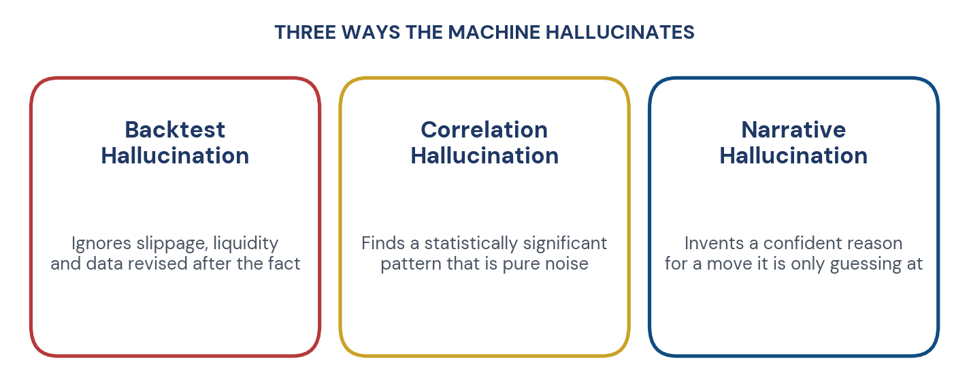
Figure 3. The three ways a machine hallucinates in trading.
We have seen portfolio managers lose millions trusting AI-generated narratives. The machine sounded so confident. The confidence was a lie.
The Human Edge That AI Cannot Copy
After all the testing, after all the arguments, after all the hype, we keep coming back to the same conclusion. The human edge in trading is not speed. It is not data processing. It is not pattern recognition.
The human edge is wisdom.
Wisdom is knowing when the rules do not apply
Livermore had rules. He broke them when the tape told him to. He paid for his mistakes. He learned from them. A machine cannot learn that way because a machine does not pay. It does not feel. It does not know the difference between a seven percent loss that hurts and a seven percent loss that destroys confidence.
Wisdom is knowing the difference between a correction and a crash
The numbers look the same for the first five percent. The tape feels different. The volume tells a story. The sentiment shifts in ways that cannot be quantified. The machine sees the numbers. The human feels the story.
Wisdom is knowing when to sit on cash
The machine sees forty percent cash as inefficient. It wants to be fully invested. It optimizes for returns without understanding that sometimes the best trade is no trade. We sit on cash because we have lived through 1987, 2000, and 2008. We know what dry powder feels like. The machine does not.
Wisdom is knowing that markets are human
They are fear and greed and hope and panic. They are not math problems. They are psychology problems dressed up in math clothing. AI can solve the math. It cannot solve the psychology because it does not have a psyche.
The Bottom Line: AI as Tool, Not Trader
Here is where we land.
AI is a magnificent tool. It screens faster than we can. It backtests more thoroughly than we can. It monitors more markets than we can. We use it every day. We would not go back to the old way.
But AI is not a trader. It cannot be. Trading requires judgment. Judgment requires experience. Experience requires pain. Pain requires a soul. The machine has none.
The hallucination is not that AI can trade. The hallucination is that trading can be reduced to a set of rules that never change. That is the lie. That is the seduction. That is what has blown up more quantitative hedge funds than we can count.
Markets evolve. Regimes shift. The rules that worked in 2010 broke in 2022. The AI found new rules. They will break too. The only constant is the human psychology underneath. Fear and greed have not changed in a hundred years. They will not change in the next hundred.
The machine can measure the fear. It cannot feel it. And because it cannot feel it, it cannot know when the fear has turned to panic, or when the panic has turned to opportunity.
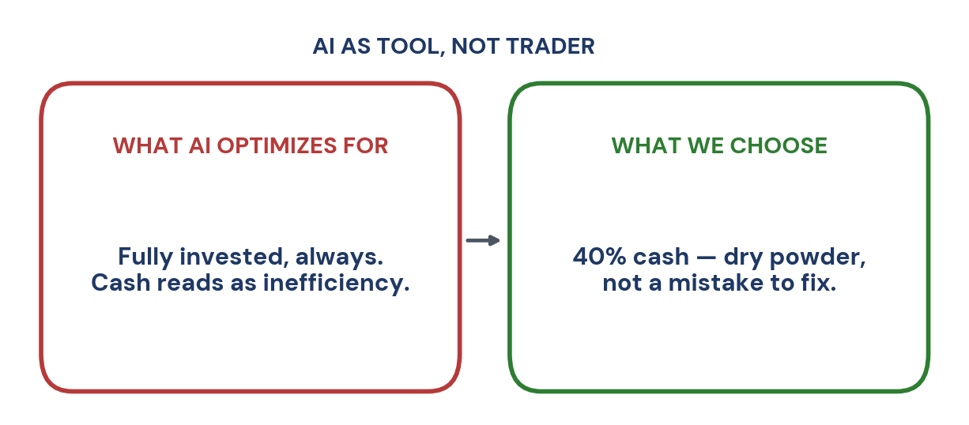
Figure 4. AI as tool, not trader — what the machine optimizes for versus what we choose.
We are not afraid of AI. We are using it. But we are not handing it the keys. The keys stay with us. They stay with humans who have read the books, felt the pain, and learned the lessons that no algorithm can learn.
That is our edge. It is not speed. It is wisdom. And wisdom is not for sale in any app store.
Sincerely,
Bull Bear Bust
**DISCLAIMER** This newsletter is published for informational and educational purposes only. Nothing contained herein constitutes investment advice, a solicitation, or a recommendation to buy or sell any financial instrument. All investment involves risk, including the loss of principal. Past commentary does not guarantee future results. Any views expressed are those of the author as of the date of publication and are subject to change without notice. Please consult a licensed financial advisor before making any investment decisions. |