Sector Spotlight · Software
The Software Sell-Off
A Contrarian's Guide to the April 2026 Bottom
Bull, Bear, Bust · 5 May 2026 · 8 min read

If you have been watching your technology holdings this year, you already know the numbers are ugly. The software sector has been hit harder than anything else in the US market. By late March, the iShares Expanded Tech-Software ETF (IGV) had fallen approximately 30 percent from its September 2025 peak, wiping out more than $830 billion in market value in just six trading sessions. At its lowest point, forward price-to-earnings multiples for the software sector compressed to 22.7 times — falling below the S&P 500 average for the first time in the cloud computing era.
KEY POINTS A quick-read snapshot of this newsletter's commentary.
▸ Software has been hit harder than anything else in the US market — IGV down approximately 30% from its September 2025 peak; roughly $2 trillion in year-to-date market value lost. ▸ Forward P/E for software has compressed to 22.7× — below the S&P 500 average for the first time in the cloud computing era. ▸ The trigger was AI fear, not bad earnings: Anthropic’s and OpenAI’s autonomous agents (Claude Cowork and Project Operator) sparked an indiscriminate sell-off. ▸ The software-to-semiconductor ratio sits 43% below its 200-day moving average — the widest gap in the dataset, exceeding even the dot-com aftermath. ▸ Goldman Sachs argues the market has conflated cause with catalyst — platform companies with proprietary data and consumption-based pricing are likely beneficiaries. ▸ Three pillars of the survivors: system-of-record status, consumption-based pricing, and strong moats AI agents cannot easily bypass. ▸ Watch list of names appearing on multiple buy lists: Oracle, Microsoft, ServiceNow, MongoDB, and Rubrik. ▸ The bottom may be in, but the recovery will not be a straight line. Expect volatility and earnings-driven differentiation. |
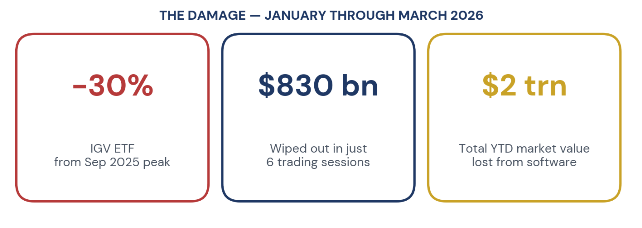 Figure 1. The damage — January through March 2026.
The question I keep hearing from readers is simple:
Is this a buying opportunity or a value trap?
The answer, as with most things in investing, depends entirely on which software companies you are looking at. But the broader picture suggests something remarkable:
The market may have overcorrected.
What Triggered the Crash?
The sell-off was not about bad earnings. In fact, short-term earnings forecasts for US software actually rose throughout February. The trigger was something else entirely: fear.
In late 2025 and early 2026, two artificial intelligence companies — Anthropic and OpenAI — released autonomous agents called Claude Cowork and Project Operator. These agents demonstrated an unprecedented ability to navigate complex business workflows without human intervention.
The market immediately concluded that if one AI agent could replace five human workers, companies would no longer need to pay for five software subscriptions. The so-called seat-based licensing model — the bedrock of the software industry for two decades — suddenly looked vulnerable.
Investors sold first and asked questions later. By the end of February, the software ETF had plunged 21% year-to-date, trailing the broader market by its widest margin since the 2000 dot-com bust.
The Technical Picture: What the Charts Are Saying
Here is where disciplined investors should pay close attention.
The software sector has now reached levels that, historically, have marked significant bottoms.
The ratio of software stocks to semiconductor stocks has fallen 43% below its 200-day moving average. According to BTIG Chief Market Technician Jonathan Krinsky, this gap is the widest in their dataset — exceeding levels seen during both the build-up to and the aftermath of the dot-com bubble.
Krinsky describes the setup as "off the charts" and calls it a key starting point for a potential reversal.
Furthermore, the IGV ETF tested the $77 level multiple times, broke below it briefly, and then recovered quickly. Technicians call this a false breakdown — a pattern that often leads to sharp moves in the opposite direction.
Bank of America technical strategist Paul Ciana notes that momentum indicators including RSI and MACD are starting to turn higher, and the ETF is attempting to reclaim its 200-week moving average.
In plain English:
The charts are flashing an oversold signal that has historically preceded significant rebounds.
The Fundamental Reassessment: Why the Fear May Be Overdone
This is the most important section of this letter. Because while the technical setup is compelling, the fundamental story is even more interesting.
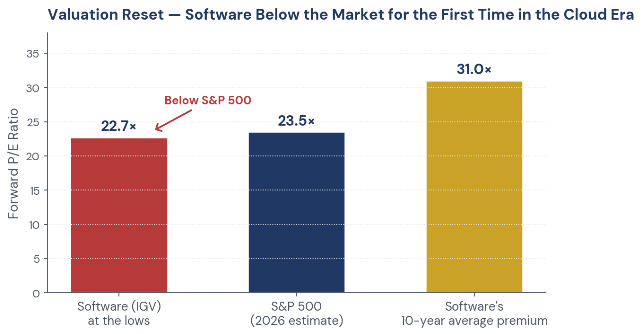 Figure 2. Forward P/E reset — software now trades below the S&P 500 for the first time in the cloud era.
Goldman Sachs recently published a detailed analysis arguing that the market has conflated cause with catalyst.
AI disruption is real, but its impact is highly uneven.
The businesses most at risk are single-function software vendors with weak customer lock-in.
The businesses least at risk — and potentially even beneficiaries — are platform companies that:
- Own proprietary data.
- Serve as systems of record.
- Provide infrastructure that AI agents cannot easily bypass.
Consider what has happened in just the past two weeks.
On April 13, Oracle disclosed a staggering $553 billion in remaining performance obligations (RPO), a massive year-over-year increase that silenced critics who doubted its cloud infrastructure capabilities.
The stock surged over 12% in a single day.
ServiceNow, after seeing its stock cut nearly in half from its highs, rebounded 7.4% after demonstrating that customers are willing to pay a premium for AI-integrated automation.
The company reported $600 million in annual contract value for its AI services.
These are not speculative bounces.
These are fundamental disclosures that directly contradict the "software is dead" narrative.
The market may have overcorrected. The fear is real — but it has been applied indiscriminately.
The Structural Shift: What Has Actually Changed
We need to be clear-eyed about what has permanently changed.
The old per-seat SaaS business model is indeed under pressure.
Companies may not need as many human users going forward, which means they may not need as many human-priced software licenses.
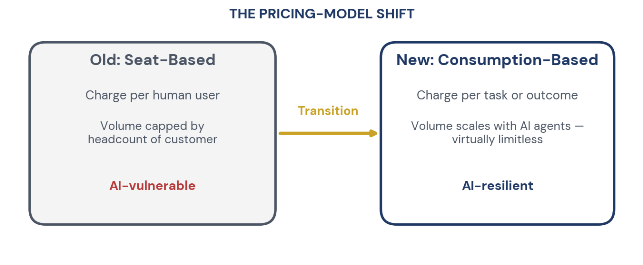 Figure 3. The pricing-model shift — from seat-based to consumption-based.
But that is not the same as saying software companies will earn less money.
The industry is shifting from a seat-based model to a consumption-based or outcome-based model.
Instead of charging per human user, software companies will charge per task performed by AI agents — and the volume of tasks is virtually limitless.
This is not a destruction of value.
It is a transformation of how value is captured.
The companies that successfully navigate this transition will likely emerge stronger, with higher margins and even stickier customer relationships.
The companies that fail will become acquisition targets or fade away.
The market, as it always does, initially painted every software company with the same brush.
That creates opportunity for those who can distinguish between the two.
So, Are We Near a Low?
Yes, with important qualifications.
The sector has already staged a V-shaped bounce in mid-April.
From its lows near $74, the IGV ETF has begun to stabilise and reclaim key moving averages.
Oracle, ServiceNow, and Microsoft have led the charge.
Bank of America has listed software stocks as a highly attractive contrarian long opportunity alongside consumer discretionary names.
However, caution is still warranted.
Bank of America’s Ciana notes that:
The speed of the recovery is reminiscent of a bull trap.
Goldman Sachs warns that uncertainty around AI disruption could keep a lid on growth-stock valuations for multiple quarters, and potentially for years.
This means that while the bottom may be in, the recovery is unlikely to be a straight line.
Expect volatility.
Expect differentiating earnings reports to separate winners from losers.
Expect the market to be unforgiving to companies that cannot show AI-driven revenue.
What Should You Do?
If you already have a position in high-quality software names, I believe this is not the time to sell.
The worst of the panic appears to be behind us.
The $2 trillion in market value lost from the software sector this year represents one of the most aggressive repricings in recent memory.
When sentiment shifts this violently, it often overshoots.
If you are considering new positions, focus on three characteristics based on analysis from Goldman, Wedbush, and MSCI.
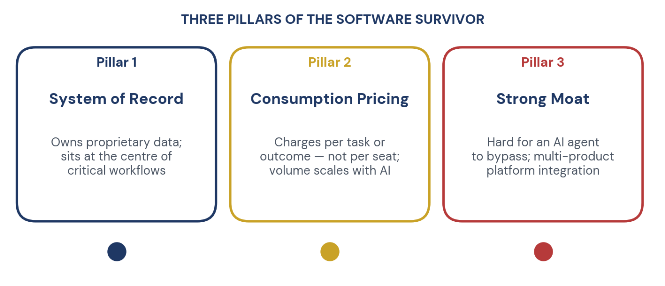 Figure 4. Three pillars of the software survivor.
1. System of Record
Prioritise platform companies that hold irreplaceable customer data and sit at the centre of critical workflows.
2. Consumption-Based Pricing
Look for companies that have already adopted consumption-based or outcome-based models.
3. Strong Moats
Avoid single-function vendors with weak moats and limited differentiation.
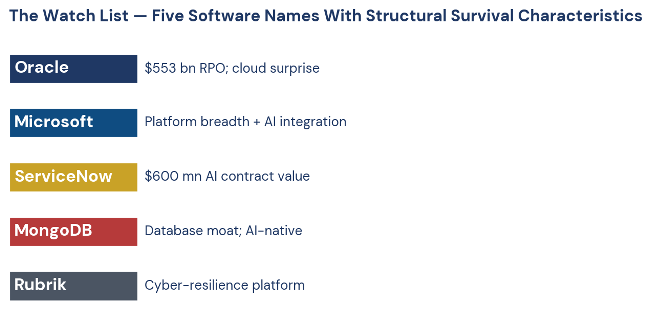 Figure 5. The watch list — five software names with structural survival characteristics.
Specific names that have appeared on multiple Wall Street buy lists include:
- Oracle
- Microsoft
- ServiceNow
- MongoDB
- Rubrik
I am not making explicit recommendations here — your personal financial situation and risk tolerance must guide your decisions — but these are the companies analysts believe have the structural characteristics to survive and thrive in the AI era.
The Final Word
The software sell-off of early 2026 will likely be remembered as a textbook example of the market overreacting to genuine but uneven technological change.
The "SaaS Apocalypse" was, in retrospect, a necessary clearing of the decks — a purge of overvalued and outdated business models that has left behind a leaner, more innovative industry.
For patient, disciplined investors, moments like this — when an entire sector trades at a discount to the broad market for the first time in years — have historically been among the best entry points of the following decade.
That does not mean every software stock will recover.
The days of automatic growth via seat expansion are over.
But the era of value creation through autonomous, AI-driven productivity has just begun.
The question is not whether software is dead.
The question is which software companies will define the next cycle.
Act accordingly.
Disclaimer This newsletter is published for informational and educational purposes only. Nothing contained herein constitutes investment advice, a solicitation, or a recommendation to buy or sell any financial instrument. Past commentary does not guarantee future results. Please consult a licensed financial advisor before making any investment decisions. |