Macro United States China Japan
Three Lights, Three Markets
Why We're Shorting US Chips, Watching China, and Buying Japan
Bull, Bear, Bust · 8 May 2026 · 16 min read
Dear Client,
The time has come to talk honestly about the most important sector in the modern stock market. For three years, semiconductors and artificial intelligence have been the engine of American equity returns. That engine is showing signs of seizing up. Not because the technology is bad. Not because the future isn't bright. But because the price paid for that future has become detached from any reasonable estimate of the cash flows that future will produce.
We are shifting our stance. Not dramatically. Not overnight. But decisively and with discipline. Let me walk you through what we are doing, country by country, stock by stock, and why.
KEY POINTS A quick-read snapshot of this newsletter's commentary
▸ We are turning bearish on US semiconductors: the Shiller CAPE Ratio sits at 37.5, last seen in 1999, and the technical picture has broken. ▸ Our US traffic light has moved from yellow to red. We are shorting the sector through SSG and SOXS rather than individual names, for roughly 7% effective short exposure. ▸ We remain neutral, yellow-light, on Chinese semiconductors: the long-term strategic case is compelling, but the short-term economic and geopolitical picture is cloudy. ▸ We are building a China shopping list: SMIC, Huawei's HiSilicon ecosystem, Montage Technology and NAURA are all on watch for an entry point. ▸ Japan is our one green light, cautiously: Tokyo Electron, Disco, Advantest, Lasertec and Sumco benefit from being neutral ground in the US-China tech cold war. ▸ We will turn more constructive on the US only if SOXX falls to $400 or below, the Fed pivots to explicit rate cuts, or China delivers a major stimulus package. ▸ Our long-term view: China wins the semiconductor war through necessity and patience, not technological superiority, but that game takes a decade, not a quarter. |
The Big Picture: Why We Are Turning Bearish on US Semiconductors
We have written extensively about the thirty crash triggers lining up on our horizon. The semiconductor and AI trade is vulnerable to nearly every single one of them.
The Iran war has spiked energy prices. Energy is a major input cost for chip manufacturing. Higher costs mean lower margins.
The Federal Reserve is trapped between inflation and recession. Either path hurts growth stocks with long duration valuations. AI stocks have the longest duration valuations in the market.
The Shiller CAPE Ratio sits at 37.5. The only time it was higher was 1999. We remember what happened to technology stocks in 2000.
The AI infrastructure narrative assumes straight-line adoption. History teaches that transformational technologies take time. The gap between promise and profit is where stock prices go to die.
And most importantly, the technical picture has broken. The S&P 500 is hovering at its 200-day moving average of 6,582. Semiconductors have led the market down. When the leader becomes the laggard, the trend has changed.
Our traffic light for United States semiconductors has moved from yellow to red. We are no longer buyers. We are now positioned to profit from the decline.
United States: Red Light — We Are Shorting the Leaders
Our US semiconductor portfolio has shifted from long to short. We are executing this shift through bearish exchange-traded funds rather than individual short sales. This gives us broad exposure without the unlimited risk of shorting single names.
What We Are Shorting
The VanEck Semiconductor ETF (SMH) is our primary vehicle for expressing a bearish view on US chips. This ETF holds the largest American semiconductor companies including Nvidia, Taiwan Semiconductor, Broadcom, and Intel. When we believe the sector is headed lower, we buy the bearish version of this ETF or short the standard version through our brokerage.
Why SMH: It is liquid. It is diversified across the entire value chain from design to manufacturing to equipment. It captures the sentiment shift without requiring us to pick which semiconductor stock will fail first. When the tide goes out, all boats sink. SMH is our tide gauge.
The Direxion Daily Semiconductor Bear 3X Shares (SOXS) is a triple-leveraged bearish ETF. We use this sparingly and in small size. Leverage cuts both ways. But for a tactical short-term position against a sector we believe is rolling over, it offers efficient use of capital. We currently hold a small position in SOXS equivalent to five percent of our US equity allocation.
Individual US Names We Are Watching (From the Short Side)
We do not short individual stocks directly. But we watch these names as confirmation signals for our thesis. When they break key levels, we add to our bearish ETF positions.
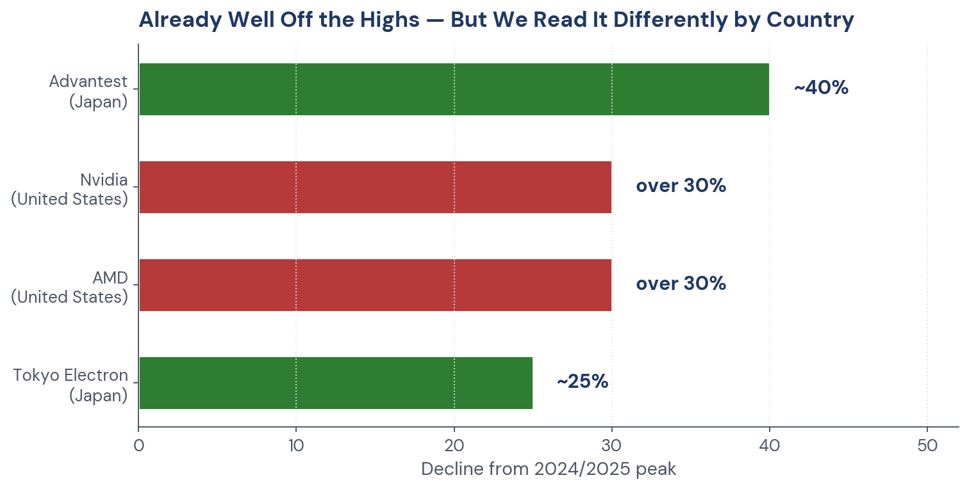
Nvidia (NVDA) is the most important stock in the world right now. Not because of its fundamentals. Because of its valuation. Nvidia trades at a price-to-earnings ratio that assumes perfect execution, infinite demand, and no competition for the next five years. The stock has already fallen more than thirty percent from its peak. We believe it has further to fall. The 200-day moving average on Nvidia sits at approximately $95 on a split-adjusted basis. A break below that level would trigger significant additional selling. We are watching this level weekly.
Advanced Micro Devices (AMD) has seen its valuation slashed more than thirty percent from its peak due to what analysts call "AI anxiety." The concern is real. AMD is gaining market share in data center chips, but the price already reflects years of share gains. When the multiple compresses, even good news gets punished. We expect AMD to test its 2024 lows before this cycle ends.
Intel (INTC) is a special case. It is not overvalued. It is struggling. Intel's foundry business is losing money. Its market share in data center has collapsed. The only reason the stock is not lower is the hope of a government bailout. We do not invest based on hope. We expect Intel to break below $20 before finding support.
Broadcom (AVGO) has diversified beyond semiconductors into software, which provides some ballast. But its networking chips are exposed to the same AI infrastructure spending cycle that is showing signs of exhaustion. Broadcom yields almost two percent, which will provide some support, but we expect the stock to correct at least twenty percent from current levels.
China: Neutral Light — Watching, Not Trading, for Now
Our stance on Chinese semiconductors is different. We are not bullish. We are not bearish. We are neutral. The traffic light is yellow.
Why Neutral
China is winning the long game in semiconductors. Not because its technology is better. Because necessity is the mother of invention. American sanctions have forced China to build its own semiconductor supply chain from scratch. That process is ugly, expensive, and inefficient. But it is happening.
The Chinese government has poured hundreds of billions of renminbi into domestic chip production. The results are mixed. SMIC, China's largest foundry, is years behind Taiwan Semiconductor. But it is catching up. And unlike American companies, Chinese semiconductor stocks do not trade on valuation. They trade on strategic importance.
However, the short-term picture is cloudy. The Chinese economy is struggling. Consumer demand is weak. The property crisis continues to drain household wealth. And the Iran war has spiked energy prices, which hurts Chinese manufacturers who are net energy importers.
We are not buying Chinese semiconductors today. We are watching. We are waiting. We are building our shopping list for the moment when the panic selling ends and the strategic reality reasserts itself.
Chinese Names on Our Watch List
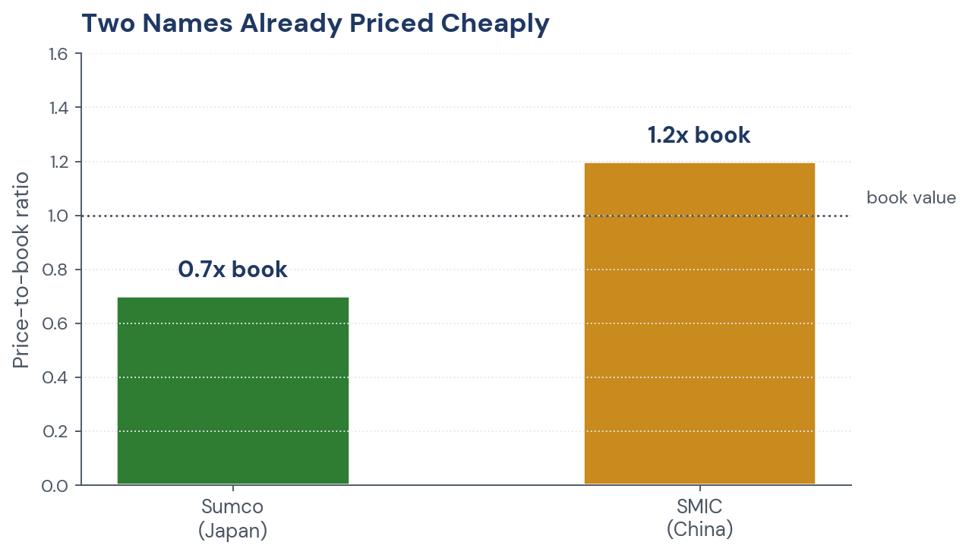
Semiconductor Manufacturing International Corporation (SMIC) is the Chinese equivalent of Taiwan Semiconductor. It is not as good. It may never be as good. But it does not need to be. It needs to be good enough to serve the Chinese domestic market. SMIC trades at a price-to-book ratio of approximately 1.2. That is not cheap by historical standards, but it is significantly cheaper than American semiconductor stocks. We will buy SMIC when the China sentiment becomes overwhelmingly negative. We are not there yet.
Huawei, while not publicly traded, drives the entire Chinese semiconductor ecosystem through its HiSilicon chip design unit. The health of Chinese semiconductors cannot be understood without watching Huawei's progress. We follow news from Shenzhen weekly.
Montage Technology (688008) is a smaller Chinese semiconductor design company focused on memory interfaces. It is profitable. It is growing. And it trades at a price-to-earnings ratio of approximately thirty, which is expensive by global standards but cheap by Chinese technology standards. We are watching this name as a potential entry point when sentiment turns.
NAURA Technology Group (002371) makes semiconductor manufacturing equipment. This is the Chinese equivalent of Applied Materials or Lam Research. If China is going to build its own supply chain, companies like NAURA will benefit. The stock has corrected significantly from its 2024 highs. We are waiting for one more leg down before initiating a small position.
Japan: Slightly Positive Light — Green But Cautious
Japan is the surprising winner in the semiconductor decoupling story. Not because Japanese chips are the best. Because Japanese chips are the safest.
Why Slightly Positive
The United States and China are engaged in a technology cold war. Japan is neutral ground. Japanese semiconductor equipment manufacturers sell to both sides. Japanese chip materials companies dominate global supply chains regardless of geopolitics. And the weak yen makes Japanese exports competitive.
The Tokyo Stock Exchange is forcing companies to improve shareholder returns. Dividend yields are rising. Share buybacks are increasing. Corporate governance is improving. These structural changes are real and they are not priced for perfection.
However, Japan is not immune to a global recession. If the United States enters a downturn, Japanese exports will suffer. And the yen, while weak, could strengthen if global risk appetite collapses, hurting the value of Japanese stocks for dollar-based investors.
We are slightly positive on Japan. The traffic light is green, but it is a cautious green. We are adding to our Japanese semiconductor positions slowly, using pullbacks as opportunities rather than chasing strength.
Japanese Names We Are Buying or Watching
Tokyo Electron (8035.T) is the Japanese equivalent of Applied Materials. It makes semiconductor manufacturing equipment. It sells to both American and Chinese chipmakers. It has a pristine balance sheet and a growing dividend. The stock has corrected approximately twenty-five percent from its 2024 peak. We have begun adding a small position and will add more on further weakness.
Disco Corporation (6146.T) makes precision cutting and grinding equipment for semiconductor wafers. It is a niche player with dominant market share. The company has no debt. It has raised its dividend for fifteen consecutive years. The stock is expensive on traditional metrics, but the quality justifies a premium. We own a small starter position.
Advantest Corporation (6857.T) makes semiconductor testing equipment. It is the global leader in memory chip testing. Memory chips are cyclical, and we are entering the down part of the cycle. But Advantest's long-term prospects are excellent. The stock has fallen almost forty percent from its peak. We are watching it closely for a buying opportunity in the next three to six months.
Lasertec Corporation (6920.T) makes inspection equipment for advanced chips. It has a near-monopoly in its niche. The stock has been a multi-bagger over the past five years. The valuation is extreme. We are not buying at these levels. But we are watching. If the stock corrects fifty percent, we will reconsider.
Sumco Corporation (3436.T) makes silicon wafers, the basic substrate for all chips. This is a commodity business with high fixed costs. Sumco is profitable, but margins are thin. The stock trades at a price-to-book ratio of 0.7. That is cheap. We own a small position as a value play on the semiconductor cycle.


The Bearish ETFs We Are Using
Let me be clear about how we are shorting. We are not using options. We are not shorting individual stocks. We are using bearish exchange-traded funds.
United States
ProShares Short Semiconductor ETF (SSG) is our primary vehicle. This ETF is designed to move in the opposite direction of the semiconductor sector. If the sector falls ten percent, SSG rises approximately ten percent. It is simple. It is transparent. And it has no leverage, so we can hold it without worrying about daily decay.
Direxion Daily Semiconductor Bear 3X Shares (SOXS) is our tactical vehicle. We use this in small size for short-term positions when we believe the sector is about to accelerate lower. The triple leverage means we can achieve our desired short exposure with less capital. But we watch it daily. Leverage is a tool, not a strategy.
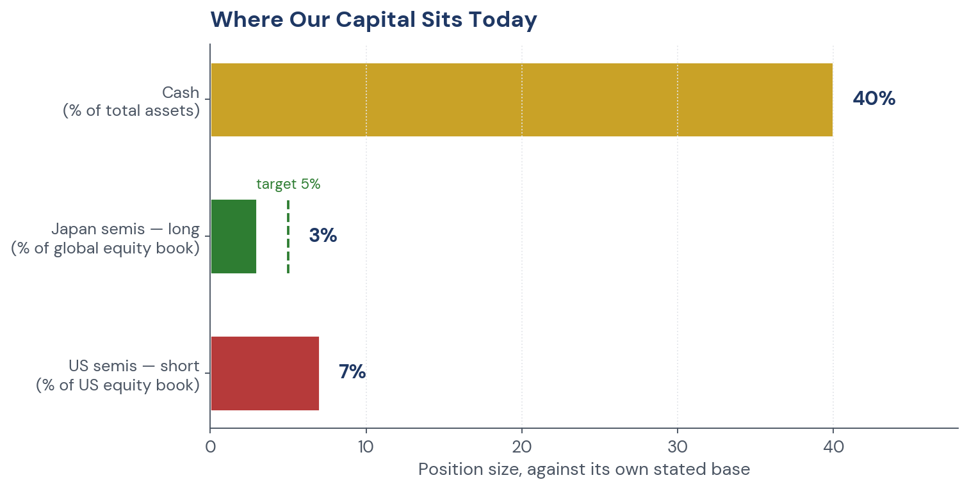
Our current allocation is five percent of our US equity portfolio in SSG and two percent in SOXS. This gives us effective short exposure of approximately seven percent to the semiconductor sector. If the sector falls twenty percent, these positions would offset losses elsewhere.
Japan
There are no efficient bearish ETFs for Japanese semiconductors specifically. We are expressing our slightly positive view by owning Japanese names directly. If we wanted to hedge or short Japan, we would use the iShares MSCI Japan ETF (EWJ) put options or short the ETF itself. We are not doing that today.
China
We are not shorting Chinese semiconductors. The neutral stance means we are watching. We have no long or short position. We are waiting.
Our Strategic Shift in Three Traffic Lights
Let me summarize our country-by-country stance clearly.
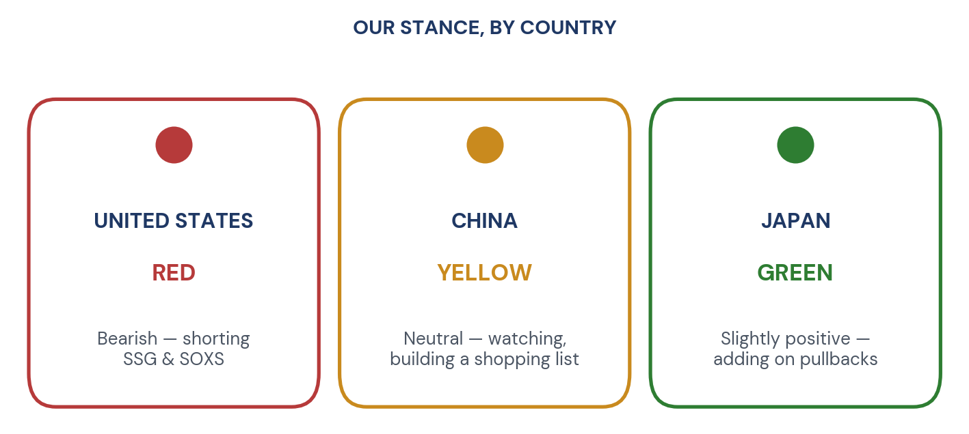

United States: Red Light
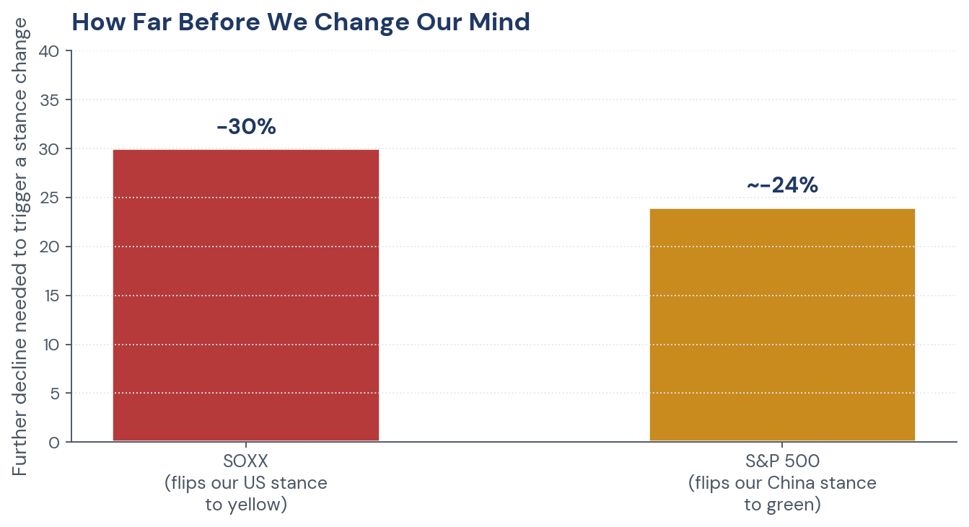
We are bearish on US semiconductors. Valuations are extreme. Technicals have broken. The AI narrative is priced for perfection in an imperfect world. We are shorting the sector through SSG and SOXS. We are not buying any US semiconductor stocks at current levels. We will revisit this stance when the SOXX ETF falls to $400 or below, approximately thirty percent lower than current levels.
China: Yellow Light
We are neutral on Chinese semiconductors. The long-term strategic case is compelling. The short-term economic and geopolitical picture is cloudy. We are watching. We are building a shopping list. We are not buying or shorting today. We will turn green when the S&P 500 falls below 5,000 and Chinese valuations become impossible to ignore.
Japan: Green Light (Cautious)
We are slightly positive on Japanese semiconductors. The companies are high quality. The balance sheets are clean. The valuations are reasonable. The geopolitical positioning is favorable. We are adding slowly on pullbacks. Our current allocation is three percent of our global equity portfolio in Japanese semiconductor names. We will increase this to five percent on a ten percent correction.
What We Are Watching to Change Our Stance
We do not make decisions in the dark. Here are the specific triggers that would cause us to change our stance in each country.
For the United States to turn from red to yellow, we need to see one of three things. First, the SOXX ETF falling to $400 or below, representing a thirty percent correction from current levels. Second, a Federal Reserve pivot to explicit rate cuts accompanied by language acknowledging recession risks. Third, a China stimulus package large enough to restart global manufacturing demand. None of these are imminent.
For China to turn from yellow to green, we need to see two things. First, the S&P 500 falling below 5,000, triggering global risk-off selling that takes Chinese stocks down with it. Second, the Chinese government announcing a credible stimulus package focused on technology self-sufficiency. We believe this combination will occur within twelve to eighteen months.
For Japan to turn from green to yellow, we would need to see three things together. A global recession that crushes export demand. A sharp strengthening of the yen that hurts the value of Japanese stocks for dollar investors. And a collapse in semiconductor capital spending. This is possible, but not our base case.

The Long-Term View: China Wins the Long Game
Let me step back from the short-term trading and give you our long-term strategic view.
China will eventually win the semiconductor war. Not because its technology will surpass American technology. Because necessity is more powerful than choice.
The United States has decided that China cannot have advanced chips. China has decided that it will build them anyway. The Chinese government has unlimited patience, unlimited resources, and unlimited strategic focus. American semiconductor companies have quarterly earnings reports.
Over the next decade, China will build a complete domestic semiconductor supply chain. It will be less efficient than the global supply chain. It will be more expensive. But it will exist. And when it exists, Chinese semiconductor stocks will trade at a premium to global peers because they serve a captive market protected by tariffs and sanctions.
We are not buying Chinese semiconductors today. But we are watching. And we are preparing. When the panic selling ends, when the headlines are bleakest, when everyone has given up on China, that will be our moment. We will buy SMIC at the lows. We will buy NAURA when it is hated. We will hold for ten years. And we will compound.
We are not in a "buy everything" environment. We are in a "be selective, maintain liquidity, and wait for better opportunities" environment.
That is the Graham in us. That is the Dreman in us. That is the Livermore in us. The big money is made in the waiting and the sitting. We are waiting. We are sitting. And when the time comes, we will strike.
What We Are Doing Right Now
Let me close with a summary of our current semiconductor and AI positioning across all three countries.
In the United States, we are short. We hold positions in SSG and SOXS representing approximately seven percent of our US equity allocation. We own no long positions in US semiconductor stocks. We sold our last remaining Nvidia shares at $135. We have no intention of buying back until the SOXX ETF corrects at least thirty percent.
In China, we are neutral. We own nothing. We are short nothing. We watch SMIC and NAURA weekly. We have a price target of thirty percent below current levels for SMIC and forty percent below current levels for NAURA. When those prices are hit, we will begin a small position.
In Japan, we are slightly positive. We own starter positions in Tokyo Electron, Disco Corporation, and Sumco Corporation. Our total Japanese semiconductor allocation is three percent of our global equity portfolio. We will add on weakness up to a maximum of five percent.
Our cash position remains forty percent of total assets. We are patient. We are disciplined. We are not chasing anything.

The semiconductors will still be here in six months. The AI revolution will still be here in six years. We do not need to buy at the top. We do not need to short at the bottom. We need to be right about the long-term direction and disciplined about the short-term execution.
We believe China wins the long game. But the long game takes time. We are prepared to wait.
DISCLAIMER This newsletter is published for informational and educational purposes only. Nothing contained herein constitutes investment advice, a solicitation, or a recommendation to buy or sell any financial instrument. All investment involves risk, including the loss of principal. Past commentary does not guarantee future results. Any views expressed are those of the author as of the date of publication and are subject to change without notice. Please consult a licensed financial advisor before making any investment decisions. |