Equities · United States · Japan · Education
The Architecture of Cycles: Understanding Market Psychology from Peak to Trough
The Wheel Always Turns
Bull, Bear, Bust · 21 August 2026 · 11 min read
Dear Client,
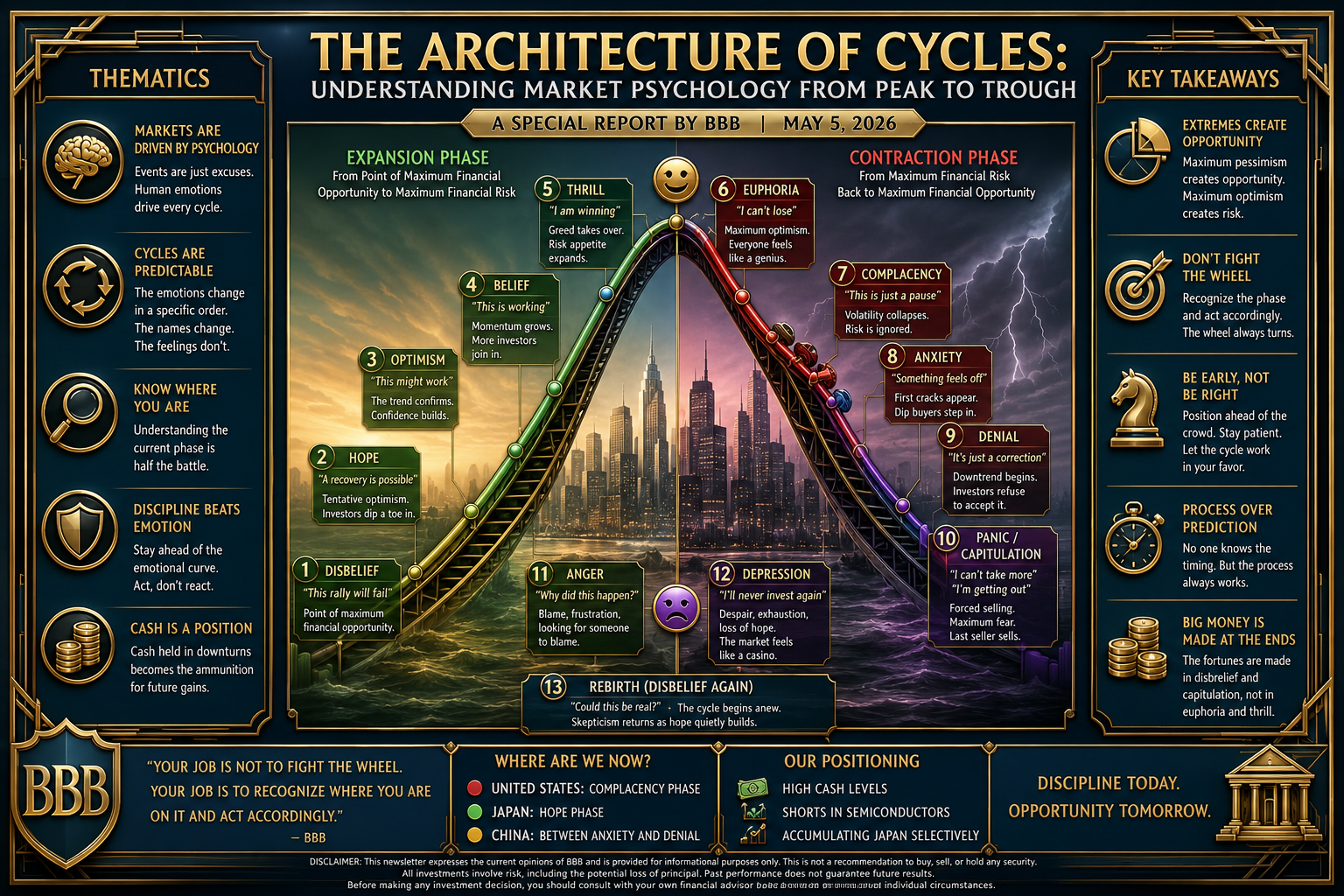
The Wall Street Cheat Sheet has been circulating in trading offices for decades. At first glance, it looks like a cartoon — a wavy line, a collection of emotional labels, a smiley face at the top and a frowning face at the bottom. But beneath that simple drawing lies the most important truth about markets. Cycles are not driven by earnings reports or interest rates or geopolitical events. Cycles are driven by human psychology. The events are just excuses. The feelings are the engine.
KEY POINTS A quick-read snapshot of this newsletter's commentary
▸ Market cycles are driven by human psychology, not by earnings, interest rates or geopolitics. The events are just excuses, and the feelings are the engine. ▸ The Wall Street Cheat Sheet is not a timing tool. It tells you where you are in the cycle, and knowing where you are is half the battle. ▸ The United States is in the complacency phase. The top is behind us, the crash has not yet arrived, and anxiety is building. ▸ Japan is in the hope phase, which rewards patience, not aggression. We are accumulating Japanese semiconductor equipment names slowly. ▸ No major market has capitulated yet. We hold our cash and wait, and when capitulation arrives we will deploy it. ▸ We raised cash and added shorts months ago. We are not reacting, we are positioned. |
Let me walk you through the structure of a complete market cycle, from the peak of euphoria to the pit of depression and back again. Understanding this architecture is the single most valuable thing an investor can do. Not because it tells you when to buy and sell. Because it tells you where you are. And knowing where you are is half the battle.
The Fundamental Architecture: Expansion and Contraction
Every market cycle has two halves. The expansion phase runs from the point of maximum financial opportunity (the bottom) to the point of maximum financial risk (the top). The contraction phase runs from the top back down to the bottom. The expansion feels long and gradual. The contraction often feels sudden and violent. But both are driven by the same psychological forces, just moving in opposite directions.
The cheat sheet divides the cycle into eight emotional stations. On the way up: Disbelief, Hope, Optimism, Belief, Thrill, Euphoria. On the way down: Complacency, Anxiety, Denial, Panic, Capitulation, Anger, Depression. These are not random adjectives. They are predictable psychological states that occur in a predictable order. The names change. The feelings do not.
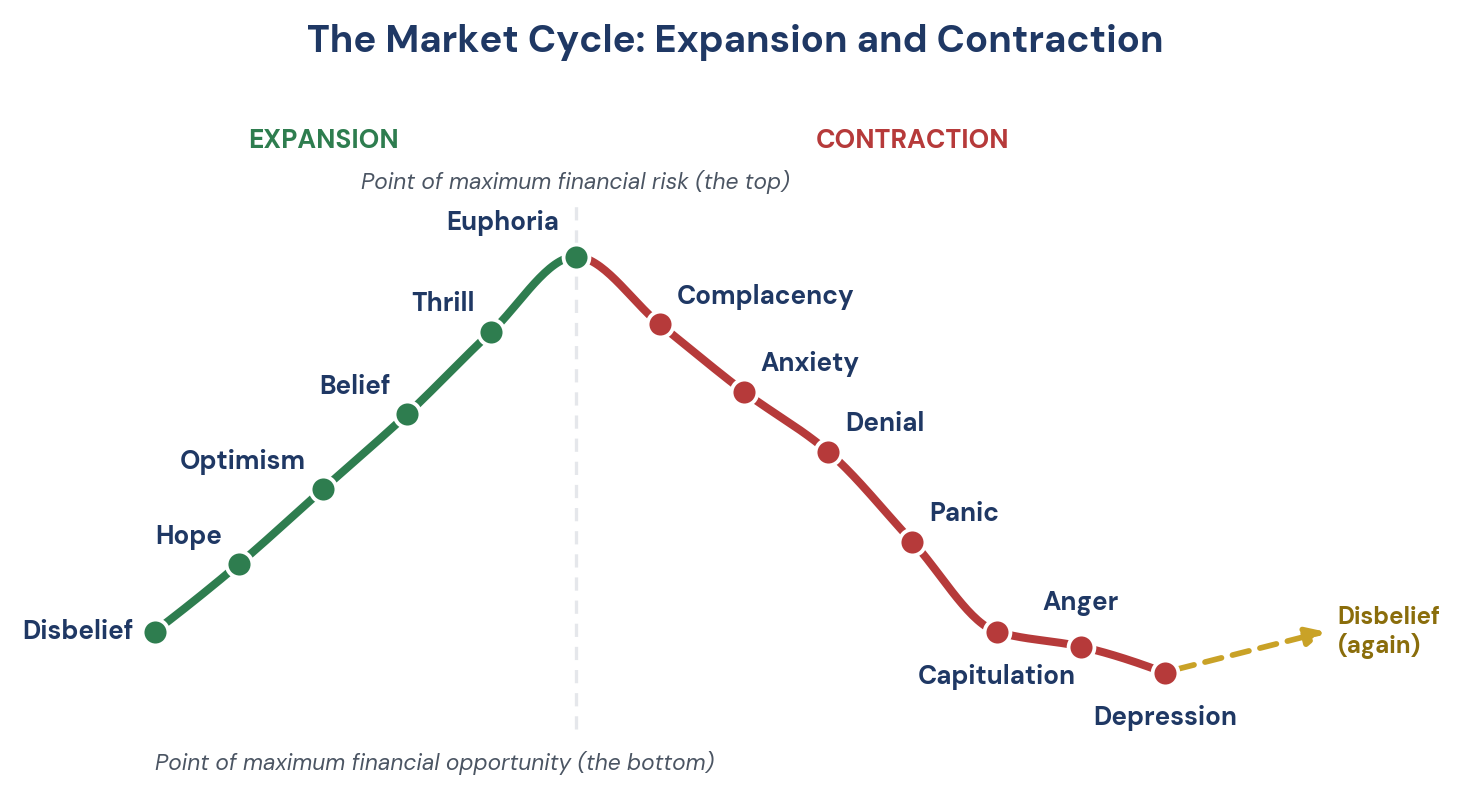 Figure 1. The emotional stations of a complete market cycle, from disbelief to depression and back.
Phase One: The Bottom — Point of Maximum Financial Opportunity
The cycle begins in darkness. Prices have been falling for months or years. The news is uniformly terrible. Everyone you know has given up on stocks. The brokerage statements go unopened. The 401k contributions get redirected to money market funds. This is the point of maximum financial opportunity, and almost no one recognizes it.
The emotional signature of this phase is disbelief. Not disbelief that prices are low. Disbelief that prices could ever go up again. The bear market has broken something in the collective psyche. The idea of making money in stocks seems naive, almost embarrassing. That is the signal. When investing becomes embarrassing, the opportunity is greatest.
What this means for us: We are not at this phase in any major market today. The United States is nowhere near maximum financial opportunity. China is closer, but not yet. Japan is somewhere in the middle. The bottom has not arrived. We hold our cash and wait.
Phase Two: The Early Recovery — Hope
The first rally arrives. It is tentative. Volume is light. The news is still bad, but the market stops going down. Investors who swore they would never buy again dip a toe back in. They tell themselves they are just trading, not investing. They tell themselves they will get out quickly if it fails.
The emotional signature is hope. Not confidence. Not conviction. Just a small flicker of possibility. The rally could fail. It often does. The last leg of a bear market is frequently the most vicious because it destroys the hope of the early recovery. But when the hope survives, when the rally holds, the cycle begins to turn.
What this means for us: Japan is in this phase. The recovery has been tentative. The hope is fragile. That is good. It means the cycle has room to run. We are accumulating Japanese semiconductor equipment names slowly, not aggressively. The hope phase rewards patience, not aggression.
Phase Three: The Confirmation — Optimism and Belief
The market has now confirmed the recovery. The 200-day moving average has turned up. Volume is expanding. The news is still cautious, but the tone is shifting. Analysts upgrade stocks from sell to hold, from hold to buy. The word "recovery" appears in headlines without scare quotes.
The emotional signature is a two-step: first optimism, then belief. Optimism says "this might work." Belief says "this is working." The difference matters. Optimism is still questioning. Belief has stopped questioning. When belief takes hold, the market enters the most rewarding phase of the cycle. Prices rise steadily. Pullbacks are shallow. Everyone who got in at the bottom feels brilliant.
What this means for us: The United States passed through this phase in 2023 and 2024. It is long gone. We are not buying the belief phase. We are preparing for what comes after.
Phase Four: The Mania — Thrill and Euphoria
This is where cycles die. The market has been rising for years. Every dip has been bought. Every skeptic has been proven wrong. The news is glowing. Your barber has stock tips. Your uncle has a margin account. The conversation at dinner parties is about how much money everyone is making.
The emotional signature is thrill, then euphoria. Thrill says "I am winning." Euphoria says "I cannot lose." The difference is critical. Thrill is still grounded in reality. Euphoria has left reality behind. In euphoria, investors take on leverage. They buy options. They ignore valuations. They believe that this time is different. They are always wrong.
The cheat sheet places "I am a genius" and "We're all getting rich" at the peak. That is not humor. That is observation. When everyone thinks they are a genius, the market is about to prove otherwise. The peak is the point of maximum financial risk because the psychology is maximum optimistic. There is no one left to buy. Only sellers remain.
What this means for us: The United States exited this phase in late 2024 or early 2025. The AI euphoria was real. The semiconductor mania was real. Now we are in the hangover. Our short positions in semiconductors are a bet that the euphoria phase is over and the contraction has begun.
Phase Five: The Top — Complacency
The market has stopped going up. It is not going down either. It drifts sideways. Volatility collapses. Everyone breathes a sigh of relief. The correction is over. The bull market will resume. This is just a pause.
The emotional signature is complacency. Not fear. Not panic. Just a quiet assumption that everything is fine. Complacency is dangerous because it disarms your defensive instincts. You stop watching your stops. You stop raising cash. You stop questioning. You assume the market will take care of itself. The market will not.
What this means for us: The United States is in this phase today. The market is hovering near its 200-day moving average. Volatility is low. Sentiment is neutral. No one is panicking. No one is euphoric. Everyone is waiting. Complacency is the breeding ground for the next crash. We are watching. We are waiting. We are ready.
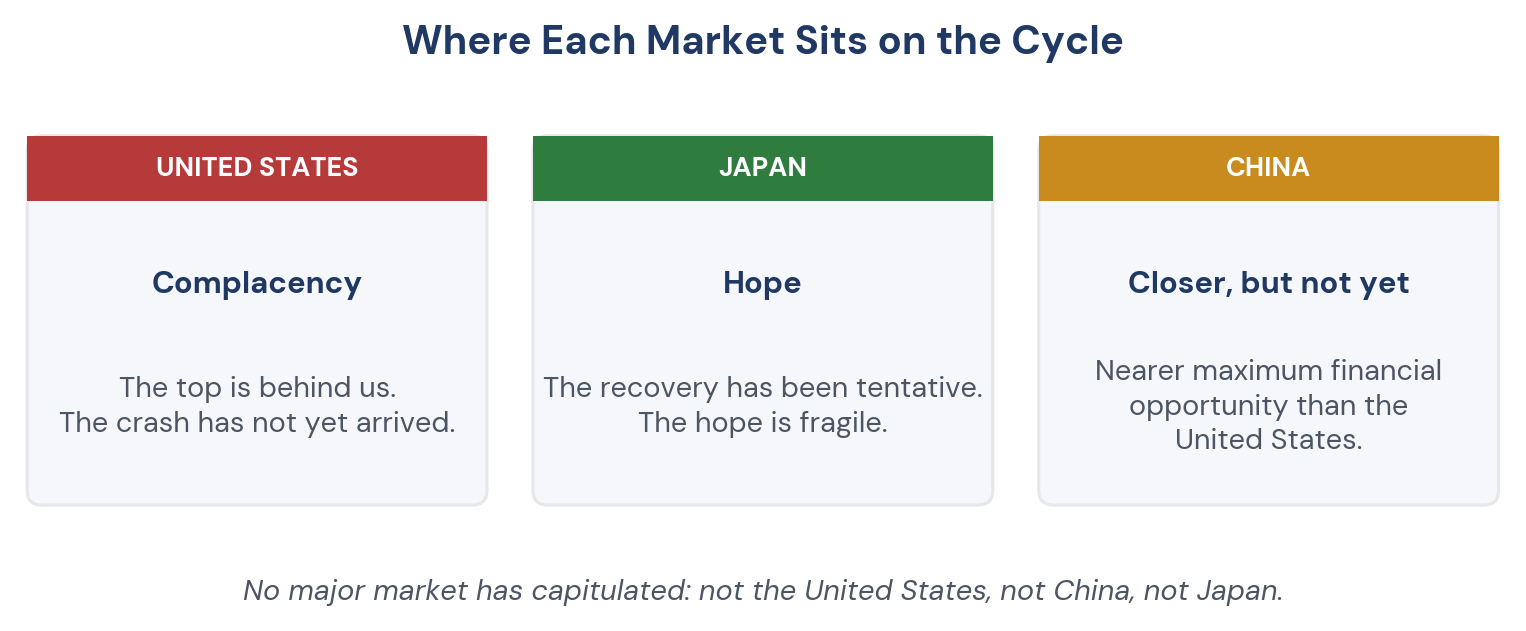 Figure 2. Where each market sits on the cycle.
Phase Six: The First Break — Anxiety
The market breaks below support. It is a small break, just a few percent. Everyone tells themselves it is a buying opportunity. The dip buyers step in. The market bounces. But the bounce is weak. Volume is low. The dip does not get fully bought.
The emotional signature is anxiety. Not panic. Just a low-grade worry. Something feels different. The easy money is gone. The news is still okay, but the market is not listening. Anxiety is the first stage of the contraction. It is also the stage where most investors make their first mistake. They buy the dip. The dip keeps dipping.
What this means for us: We saw this phase in March 2026. The market broke. It recovered. But the recovery was on low volume. The anxiety was real. Our answer was not to buy the dip. Our answer was to raise cash and add shorts. We are not dip buyers in a distribution phase. We are sellers of strength.
Phase Seven: The Realization — Denial
The market is clearly in a downtrend now. The 200-day moving average has been broken. The losses are real. But investors refuse to accept it. They tell themselves it is just a correction. They tell themselves the fundamentals are still good. They tell themselves the market will come back.
The emotional signature is denial. This is the most dangerous phase because denial prevents action. You should be selling. Instead, you are hoping. You should be raising cash. Instead, you are looking for bargains. Denial turns a manageable loss into a catastrophic one.
What this means for us: We are not in denial. We are already positioned for the downturn. Our cash is high. Our shorts are in place. Our stops are tight. We will watch others go through denial. We will not join them.
Phase Eight: The Panic — Fear and Capitulation
The selling accelerates. Volume spikes. Every day brings new lows. Margin calls go out. Forced selling begins. The news turns apocalyptic. The word "crash" appears in headlines. Investors who swore they would never sell throw in the towel.
The emotional signature is fear, then capitulation. Fear says "I am losing money." Capitulation says "I cannot take any more." Capitulation is the moment when the last seller sells. It is the point of maximum financial opportunity, but no one can see it because the pain is too intense.
The cheat sheet captures this perfectly: "I can't afford to lose more" and "I'm getting 100% out of the markets." That is capitulation. That is the bottom. Not the price. The feeling.
What this means for us: We are not in this phase today. The United States has not capitulated. China has not capitulated. Japan has not capitulated. When capitulation finally arrives, we will deploy our cash. Not before. Livermore taught us to buy the blood. There is no blood yet.
Phase Nine: The Aftermath — Anger and Depression
The market has bottomed. The selling is exhausted. But no one wants to buy. The scars are too fresh. Investors are angry at the regulators, the Fed, the short sellers, the hedge funds, anyone except themselves. Then the anger fades into depression. Retirement accounts are destroyed. Dreams are deferred. The market seems like a casino, not an investment vehicle.
The emotional signature is anger, then depression. This phase can last for months or years. The 1930s were a decade of anger and depression. The 1970s were a decade of anger and depression. The 2000s, after the dot-com crash, had a long stretch of anger and depression. This is the fallow period. The seeds of the next cycle are being planted, but no one can see them.
What this means for us: We will be buyers in this phase. Not at the beginning. At the end, when the depression is deepest and the opportunity is greatest. That is how Graham made his fortune. That is how Dreman made his fortune. That is how we plan to make ours.
Phase Ten: The Rebirth — Disbelief (Again)
The market has been rising quietly for months. No one notices. Volume is light. The news is still skeptical. Investors who swore they would never buy again start to wonder. The feeling is not hope. It is disbelief. Disbelief that the market is actually going up. Disbelief that the recovery could be real.
This is the same disbelief that marked the bottom of the previous cycle. The emotions are identical. The names have changed. The wheel turns.
What this means for us: We will be fully invested in this phase. Not because we are optimistic. Because we followed our process through the entire cycle. We raised cash at the top. We held through the decline. We deployed at the bottom. We compounded through the recovery. That is the only way to win the long game.
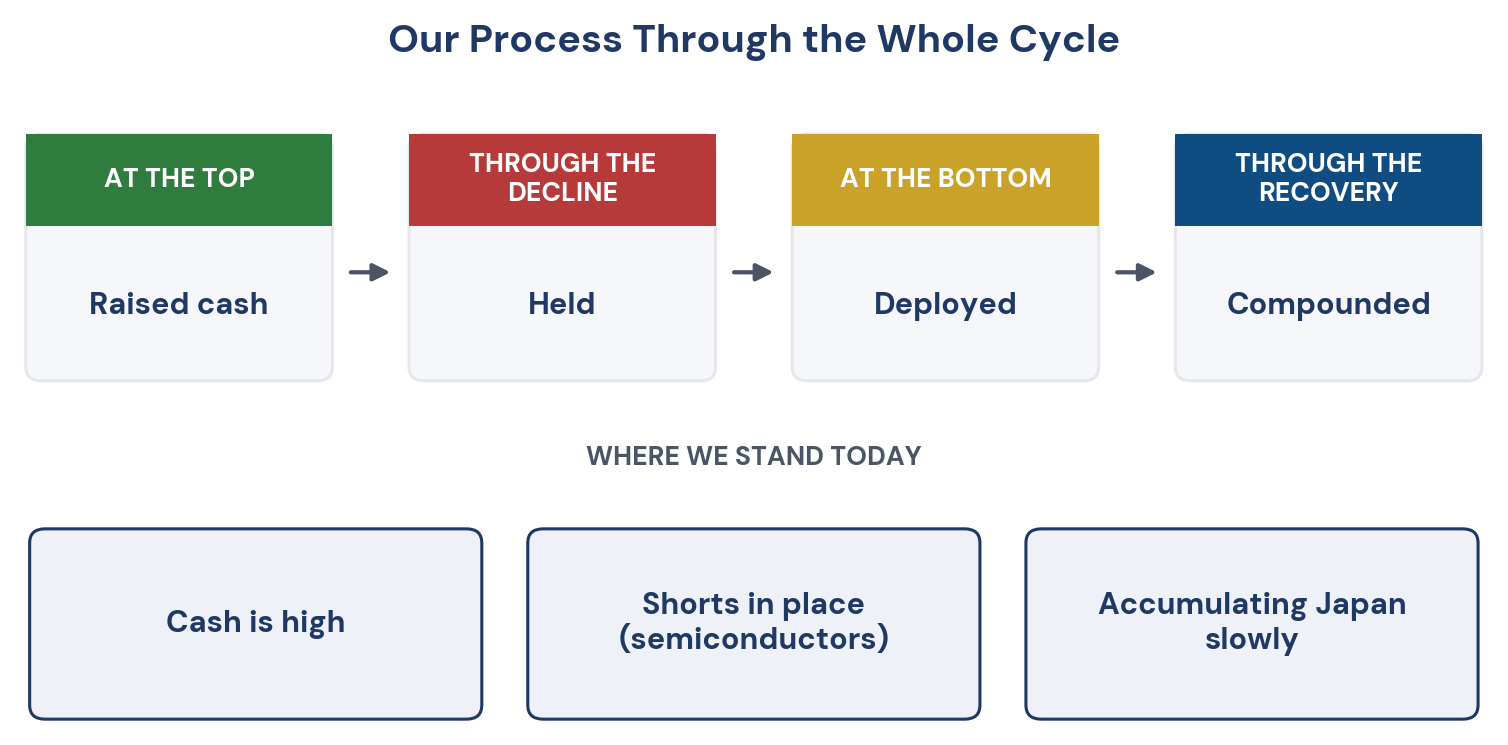 Figure 3. Our process through the whole cycle, and where we stand today.
The Lesson in One Paragraph
The cheat sheet is not a timing tool. It does not tell you when to buy or sell. It tells you where you are. That is enough. If you know you are in euphoria, you should be raising cash, not buying more. If you know you are in capitulation, you should be buying, not selling. If you know you are in denial, you should be looking honestly at your portfolio, not hoping for a rescue.
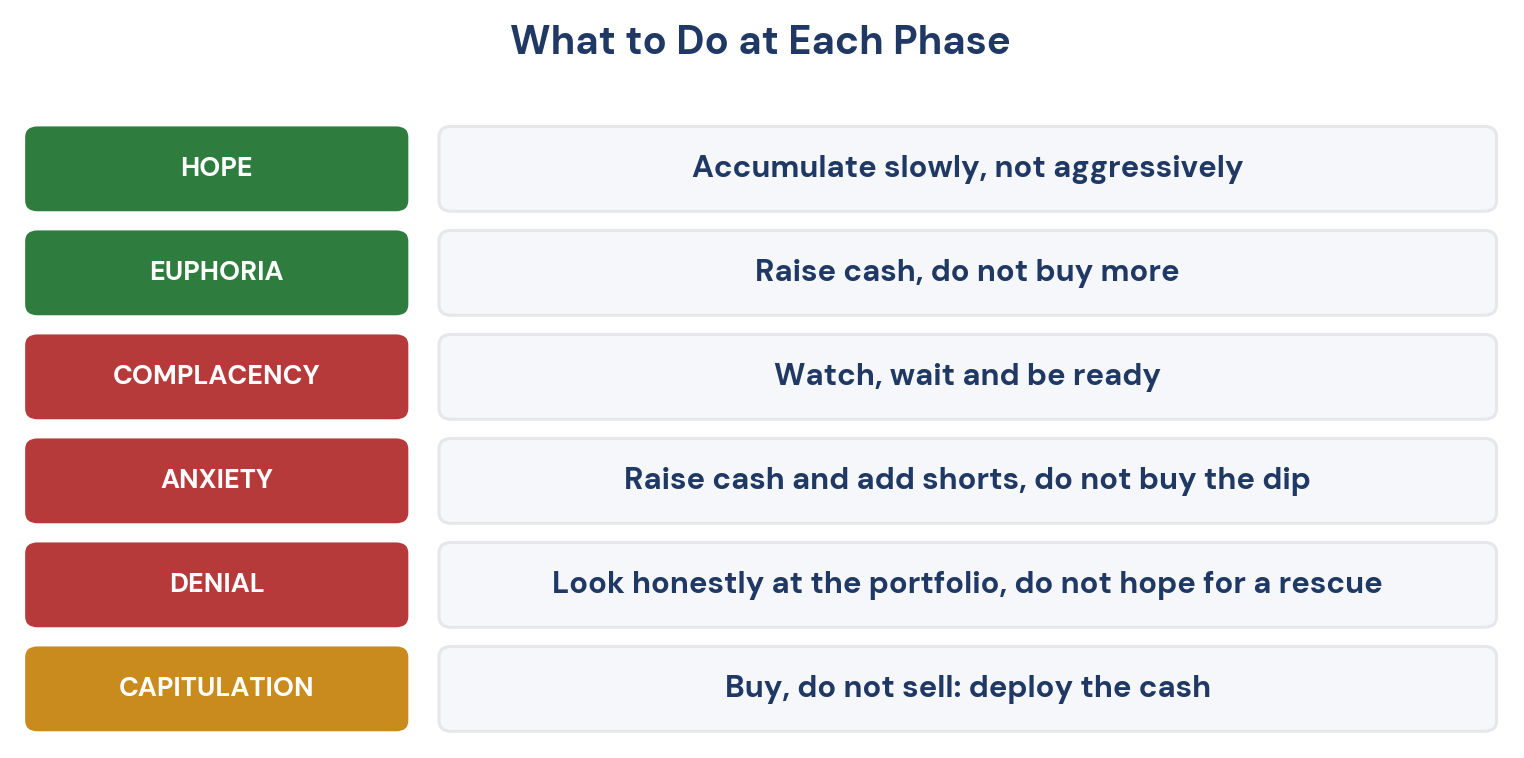 Figure 4. What to do at each phase.
We are in the complacency phase in the United States. The top is behind us. The crash has not yet arrived. The anxiety is building. The denial is coming. Our job is to stay ahead of the emotional curve. We raised cash months ago. We added shorts months ago. We are not reacting. We are positioned.
The wheel always turns. Euphoria becomes complacency. Complacency becomes anxiety. Anxiety becomes panic. Panic becomes capitulation. Capitulation becomes disbelief. Disbelief becomes hope. Hope becomes optimism. Optimism becomes euphoria again.
Your job is not to fight the wheel. Your job is to recognize where you are on it and act accordingly.
Sincerely,
Bull Bear Bust
DISCLAIMER This newsletter is published for informational and educational purposes only. Nothing contained herein constitutes investment advice, a solicitation, or a recommendation to buy or sell any financial instrument. All investment involves risk, including the loss of principal. Past commentary does not guarantee future results. Any views expressed are those of the author as of the date of publication and are subject to change without notice. Please consult a licensed financial advisor before making any investment decisions. |