Equities · Education
The Investor's Treasury: 50 Essential Quotes from Classics: An Investor's Anthology
It Is Not Complicated. It Is Not Easy. But It Works.
Bull, Bear, Bust · 18 August 2026 · 19 min read
Dear Client,
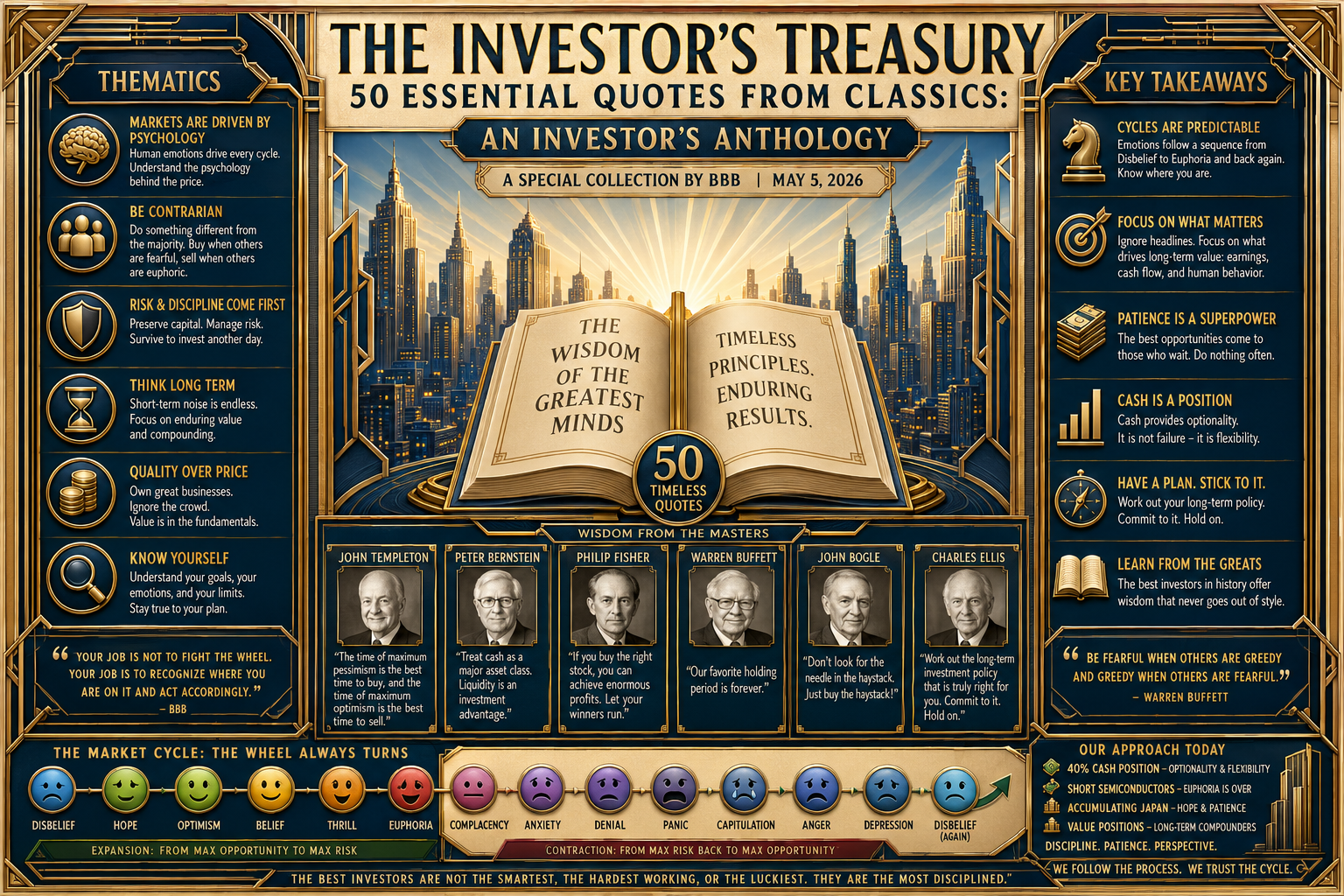
There are books that teach you how to invest. And then there are books that teach you how to think about investing. Charles D. Ellis and James R. Vertin's Classics: An Investor's Anthology belongs to the second category. It is not a how-to manual. It is a collection of the wisest voices in financial history, gathered together so you can sit at their feet and listen.
KEY POINTS A quick-read snapshot of this newsletter's commentary
▸ Classics: An Investor's Anthology, edited by Charles D. Ellis and James R. Vertin, is not a how-to manual. It is a collection of the wisest voices in financial history, and these fifty quotes have shaped how we see markets and manage risk. ▸ The greatest investors are not the smartest and not the hardest working. They are the most disciplined. They have a plan, they stick to the plan and they ignore the noise. ▸ Templeton: the time of maximum pessimism is the best time to buy, and the time of maximum optimism is the best time to sell. Your gut will scream the opposite, and that is the point. ▸ Ellis describes three ways to seek superior results: one physically difficult, one intellectually difficult and one emotionally difficult. Hard work is the entry ticket, not the edge. The emotionally difficult path is to make a plan, commit to it and hold on. ▸ Cash is a position, not a failure. Our forty percent cash is an asset allocation decision, not a market call. ▸ We buy Japanese semiconductor equipment companies slowly, on pullbacks, short American semiconductors through bearish ETFs, and hold our value positions in financials, healthcare and software. We are not selling, panicking or chasing. We are sitting. |
I have spent many evenings with this book. The pages are marked. The corners are folded. The margins contain questions I asked myself years ago and am still trying to answer. What follows are fifty quotes that have shaped how I see markets, how I manage risk, and how I try to stay sane when the world feels like it is burning down around us.
Read them once. Then read them again. The best ones will stay with you for the rest of your investing life.
From the Master Himself: Edward C. Johnson II
- "The stock market represents everything that anybody has ever hoped, feared, hated, or loved. It is all of life."
This is the opening salvo of the entire anthology, and it is perfect. The market is not a calculator. It is not a spreadsheet. It is the collective soul of humanity poured into ticker symbols. When you forget this, you forget everything.
John Templeton: The Contrarian's Contrarian
- "It is impossible to produce a superior performance unless you do something different from the majority."
This is Templeton's most important rule. It appeared in the fourth-to-last chapter of the anthology, titled "The Time Tested Maxims of the Templeton Touch". If everyone loves the same stock, the opportunity is gone. If everyone hates the same stock, the opportunity is just beginning.
- "The time of maximum pessimism is the best time to buy, and the time of maximum optimism is the best time to sell."
This is number four in Templeton's list. The quote is simple. Living it is nearly impossible. When the world is burning, you must buy. When the world is celebrating, you must sell. Your gut will scream the opposite. That is the point.
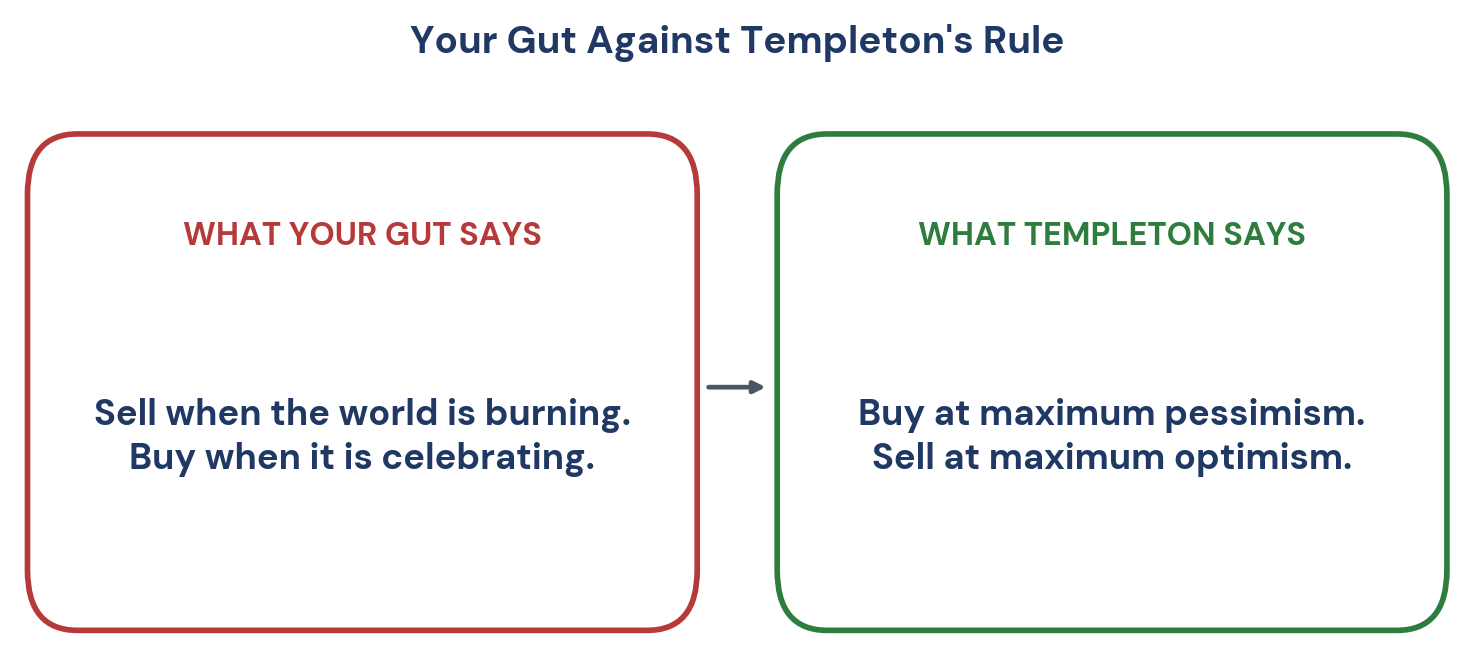 Figure 1. What your gut says against what Templeton says.
Peter Bernstein: The Philosopher of Risk
- "Growth companies are those with creative and imaginative teams. Growth stocks are simply stocks whose prices have gone up."
From Peter Bernstein, as recorded in one investor's reading notes on the anthology. The distinction is everything. A growth company is a living organism. A growth stock is a price tag. Do not confuse them.
- "Why should traditional asset allocation only consider stocks and bonds? Treat cash as a major asset class. A 75% stock and 25% cash portfolio has similar risk to a 60% stock and 40% bond portfolio, but with higher returns."
Bernstein challenging the orthodoxy. We have taken this to heart. Our forty percent cash position is not a market call. It is an asset allocation decision. Cash is a position. It is not failure.
Gustave Le Bon: The Crowd Psychologist
- "The thinking capacity of a crowd is always inferior to that of an individual. But in certain situations, the actions of a crowd can be superior to individual action. Crowd actions are determined by emotions that dominate the subconscious."
Le Bon wrote about crowds long before the first ticker tape ever printed. He understood that markets are not rational. They are emotional. They are subconscious. They are the id unleashed. Do not expect logic from a crowd. Expect momentum, panic, and the occasional miracle.
Sidney Homer: The Historian of Credit
- "Of all forms of capital, credit is the most productive."
Sidney Homer traced interest rates from ancient Babylonia to modern New York. He understood that credit is not just money. It is trust made visible. When credit expands, markets rise. When credit contracts, markets fall. Watch the credit.
Claude Rosenberg: The Quality Seeker
- "Focus on quality stocks, not inferior goods."
Simple. Direct. Forgotten by almost everyone during a mania. When the crowd is buying garbage, hold quality. When the crowd is selling quality to buy more garbage, buy more quality.
John Burr Williams: The Dividend Prophet
- "The value of a stock lies in its dividends."
Williams wrote the book on present value. He understood that a stock is worth the cash it will pay you over its lifetime, discounted back to today. Everything else is speculation dressed up as analysis.
Walter Gutman: The Dreamer
- "We cannot imagine wealth greater than our dreams."
Gutman understood that markets are driven by imagination. The dot-com bubble. The AI bubble. Every bubble. Dreams first. Reality later. The trick is to ride the dream and exit before the alarm clock rings.
Roger Ibbotson: The Data Keeper
- "The U.S. stock market is the largest and most watched market in the world."
Ibbotson gave us the history of returns. Context matters. The American market is special. It has survived wars, depressions, panics, and pandemics. That does not mean it will never fall. It means it will always come back.
Mike Royko: The Skeptic
- "The stock market, judged only by headlines or radio broadcasts, resembles the condition of a manic-depressive patient."
Royko, the great Chicago columnist, saw through the noise. The market is not stable. It is not calm. It is a patient swinging from mania to depression and back again. Do not mistake the mood for the diagnosis.
Henry Dunn: The Humble One
- "The world of investing is filled with complex problems and unpredictable uncertainty."
Dunn admitted what few on Wall Street will admit. No one knows. The best investors are not the ones who predict correctly. They are the ones who prepare for every possibility.
Philip Fisher: The Growth Pioneer
- "If you buy the right stock, you can achieve enormous profits. There are only three reasons to sell: you bought the wrong stock, the conditions have changed, or you have found a better opportunity."
Fisher wrote about growth investing before growth investing was a thing. Notice what is not on his list. Taxes. Fear. The need to lock in a profit because it feels good. He sold for three reasons only. We try to do the same.
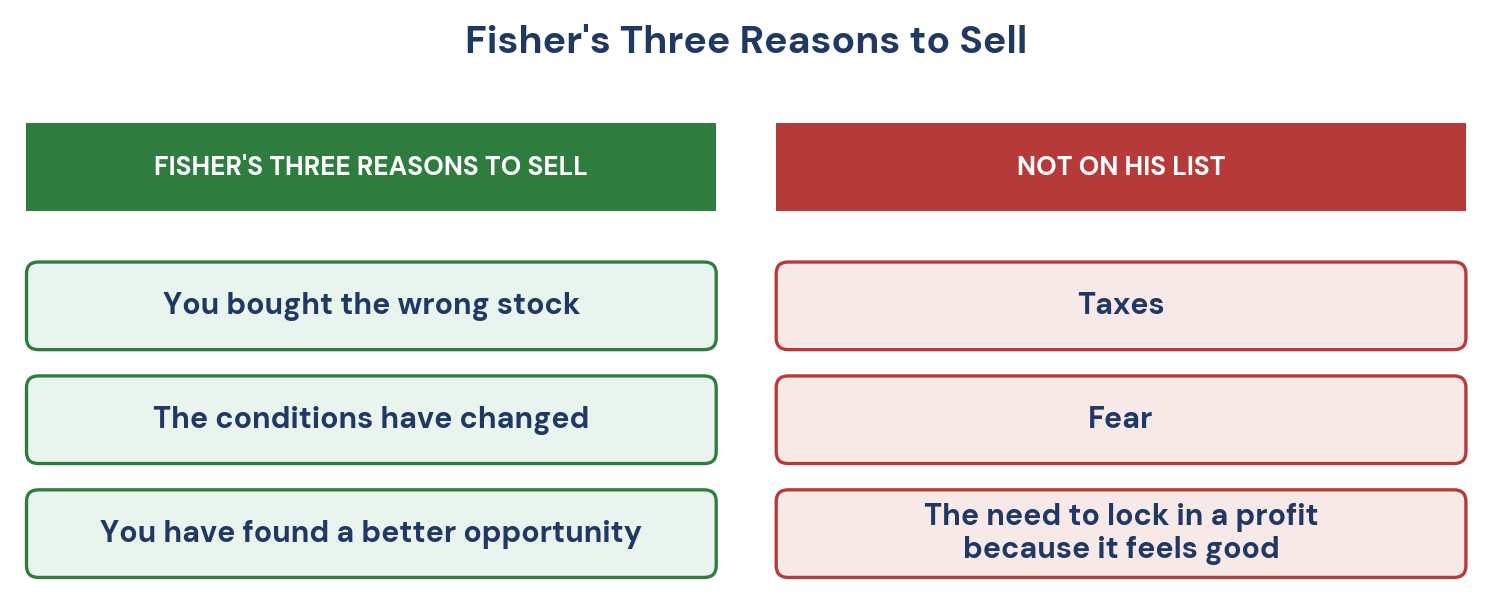 Figure 2. Fisher's three reasons to sell, and what is not on his list.
Charles Ellis: The Editor Himself
- "Investing is a competition of intelligence, physical endurance, and perseverance."
Ellis, the man who compiled this anthology, knew what he was talking about. Intelligence gets you in the game. Endurance keeps you in the game. Perseverance wins the game.
James Gipson: The Observer of Youth
- "Young people have plenty of time to enjoy the benefits of long-term investing, but they are usually the most impatient."
Gipson nailed it. Time is the young investor's greatest asset. And the young investor wastes it on trading, chasing, and hoping. Patience is a superpower. It is also rare.
George Ross Goobey: The Pioneer of Pension Investing
- "Human nature always places too much weight on costs already incurred. Investors are more likely to sell when they have a profit than when they have a loss."
Goobey identified the disposition effect decades before behavioral economists gave it a name. We sell winners too early and hold losers too long. The rule cuts both ways. Let winners run. Cut losers fast.
Arthur Zeikel: The Questioner
- "Most people have an instinctive resistance to change. They predict the future based on the present, and therefore their expectations are often disappointed."
Zeikel's essay "On the Threat of Change" appears in the anthology. Change is the only constant. Markets that extrapolate the present always get blindsided. We try to imagine the future that nobody else sees.
- "Why are so many of us wrong so much of the time?"
The haunting question from Zeikel's probing essay. The answer is because we are human. We are overconfident. We are biased. We see what we want to see. The first step to being right more often is admitting how often we are wrong.
Barton Biggs: The Global Strategist
- "People do not become smarter because of experience. They become smarter because of their ability to learn from experience. It takes ten years for a manager to understand his industry well enough to become an investment expert."
Biggs contributed nuggets of useful advice in his essay "Investment Strategy". Experience is not enough. Reflection on experience is what matters. Ten years. That is the apprenticeship. Do not rush it.
Edward Johnson: The Present-Moment Guru
- "Many people spend their entire lives thinking about the future, so much so that they rarely notice the present."
Johnson understood that the future is imaginary. The present is real. The market trades in the present. The news is about the present. Do not live in tomorrow. Live in today.
John Train: The Witty One
- "In a downturn, it is better to buy stocks than pigs. Pigs do not pay dividends, and you have to buy them feed."
Train's humor masks deep wisdom. Real assets matter. Dividends matter. When the world is panicking, own things that produce cash. Do not own things that consume it.
Byron Wien: The Self-Examiner
- "Review the mistakes you have made in the past few years."
Wien's advice is simple and brutal. Selling too fast. Holding too long. Believing the narrative. Underestimating the problem. Write down your mistakes. Read the list every quarter. Do not make the same ones twice.
Nigel Lawson: The Big-Picture Thinker
- "Smart investors pay attention to factors beyond the numbers."
Lawson understood that numbers are the map, not the territory. Culture matters. Politics matters. Human nature matters. The numbers are just the printout of the human decisions underneath.
Fred Young: The Courageous One
- "One essential ingredient of successful stock investing is courage."
Young said it plainly. Not intelligence. Not education. Not a better spreadsheet. Courage. Courage to buy when everyone is selling. Courage to hold when everyone is panicking. Courage to be different.
Hans Christian Andersen: The Storyteller
- "You cannot see only what you want to see."
The fairy tale writer, of all people, understood investing. Confirmation bias is the investor's curse. We see what supports our position. We ignore what threatens it. The discipline is to look for what you do not want to see.
Paul Samuelson: The Economist's Economist
- "After a drought, the following months are typically even drier."
Samuelson understood reversion to the mean, and he also understood that reversion takes time. Do not buy the first dip. Do not trust the first rally. The trend often continues longer than seems reasonable.
Daniel Bernoulli: The Mathematician
- "Value cannot be determined by price alone, but must be calculated by utility. One thousand dollars has greater utility for a poor person than for a rich person."
Bernoulli gave us the concept of diminishing marginal utility. The same gain means different things to different investors. Know your own utility curve. Do not chase gains you do not need.
Arnold Bernhard: The Inflation Watcher
- "Even if your assets double in value, your purchasing power may be cut in half by inflation."
Bernhard understood the silent thief. Nominal returns are not real returns. Inflation is not a footnote. It is the main event. We invest to preserve purchasing power. Everything else is secondary.
Bradlee Perry: The Turnaround Believer
- "Because of competitive factors, companies and stocks usually recover from the bottom."
Perry was an optimist in a profession that rewards pessimism. The cycle always turns. The company that is hated today may be loved tomorrow. Not always. But usually.
Robert Kirby: The Performance Skeptic
- "Investment managers are rational. But the stock market is not. Do not evaluate performance based on short-term numbers of two or three years."
Kirby understood the mismatch. Rational managers. Irrational markets. The combination produces strange results in the short run. In the long run, rationality wins. In the short run, anything can happen.
I.M.D. Little: The Growth Skeptic
- "Unless the economy experiences a change that improves capital efficiency, future stock returns will not be as high as historical data suggests."
Little warned against extrapolating the past. The last twenty years were not normal. The next twenty years may not be either. We plan for lower returns. If we get higher returns, we will be pleasantly surprised.
David Babson: The Forecaster's Critic
- "If anyone could consistently and correctly predict stock prices, they would quickly become enormously wealthy and would not need to sell their predictions to the public."
Babson's essay "The Futility of Stock Market Guessing" appears in the anthology. This is the final word on market timing. If the guru could predict the future, they would be on a beach, not on television. Trust actions, not words.
T. Rowe Price: The Goal-Setter
- "Before buying a stock, ask yourself: what is my purpose? Capital preservation, income, or capital appreciation? Choose companies on a growth trajectory, and you will succeed."
Price revealed the secrets of his phenomenal success in mutual funds. Know why you are buying. The answer changes everything. A stock that is right for one purpose is wrong for another.
Phineas Barnum: The Showman
- "Success must depend on your own efforts. Your own wealth can only be built by your own hands."
Barnum's "Rules for Success in Business" appears in the anthology's final section on tips, rules, and commandments. No one will save you. No one will hand you the answer. Your wealth is your responsibility.
Dean Mathey: The Stress-Tester
- "Constantly examine yourself. When conditions are at their worst, ask whether you still have the ability to repay."
Mathey understood that booms reveal nothing. Busts reveal everything. Stress-test your portfolio for the worst-case scenario. If you would not survive it, reduce your risk now.
Roy Neuberger: The Independent One
- "Do not trust anything lightly. Dig your own gold mine. Think twice before acting. Fools are created every minute."
Neuberger's almanac appears in the anthology. The world is full of people who want to separate you from your money. Do not give them the chance. Your gold mine is your own analysis. Dig it yourself.
Douglas Bellemore: The Aggressive Investor's Checklist
- "The aggressive investor requires greater effort, patience, courage, calm, and wisdom."
Bellemore listed the virtues. Notice what is not on the list. Leverage. Speed. Tips. Aggressive investing is not reckless investing. It is disciplined investing with a higher risk tolerance. The virtues are the same. The stakes are higher.
Warren Buffett: The Introspective One
- "Every investor will benefit from the classics found in this volume."
Buffett wrote this blurb for the book. He was not being polite. He meant it. The classics teach what the news cannot. They teach perspective. They teach patience. They teach the long view.
Buffett also contributed an introspective, illuminating piece titled "Mistakes of the First Twenty-Five Years". The richest investor in history spent twenty-five years making mistakes. Then he spent the next forty years not making the same ones. That is the secret.
John Bogle: The Indexer's Champion
- "From A-B-C to Z... eternal wisdom about the financial markets, compiled by one of the most astute minds in the field. A must-read for the serious investor."
Bogle, the founder of Vanguard, endorsed this book. He understood that wisdom is not about picking the winning stock. It is about understanding the game. This book teaches the game.
John Neff: The Value Seeker
- "Now—at last—an opportunity for individual investors to sample the writing of the outstanding investors of our time, carefully crafted by Charley Ellis."
Neff, the legendary manager of Windsor Fund, praised the anthology. He knew that reading the greats is the shortest path to becoming great. You do not have to learn everything by losing your own money. You can learn from their losses instead.
Steven Einhorn: The Partner
- "This book is must reading for anyone interested in investing. It contains everything one would expect in a great book — wisdom, insight, historical perspective, and wit."
Einhorn, a partner at Goldman Sachs, understood that investing is not a technical discipline. It is a liberal art. It requires wisdom. It requires perspective. It requires wit. The numbers are just the starting point.
Byron Wien (Again): The Strategist
- "Ideas change the world, and this book enables you to observe the key moments in investment thinking over the past two hundred years. If having clear perspective improves investment performance, reading this book will help you make better decisions."
Wien again, this time emphasizing the power of ideas. The market is not driven by data. It is driven by ideas. The ideas that dominated in 1920 are different from the ideas that dominate today. But the structure of ideas — the way they rise, dominate, and fall — never changes.
Charles Ellis (Again): The Three Paths
- "There are three ways in which you might try to achieve superior results: one is physically difficult; one is intellectually difficult; and one is emotionally difficult."
This is from Ellis's own essay in Classics II, but it belongs in any list of investment wisdom. The physically difficult path is working harder — more hours, more reports, more calls. The intellectually difficult path is seeing the future more clearly than anyone else. The emotionally difficult path is buying a plan and holding on.
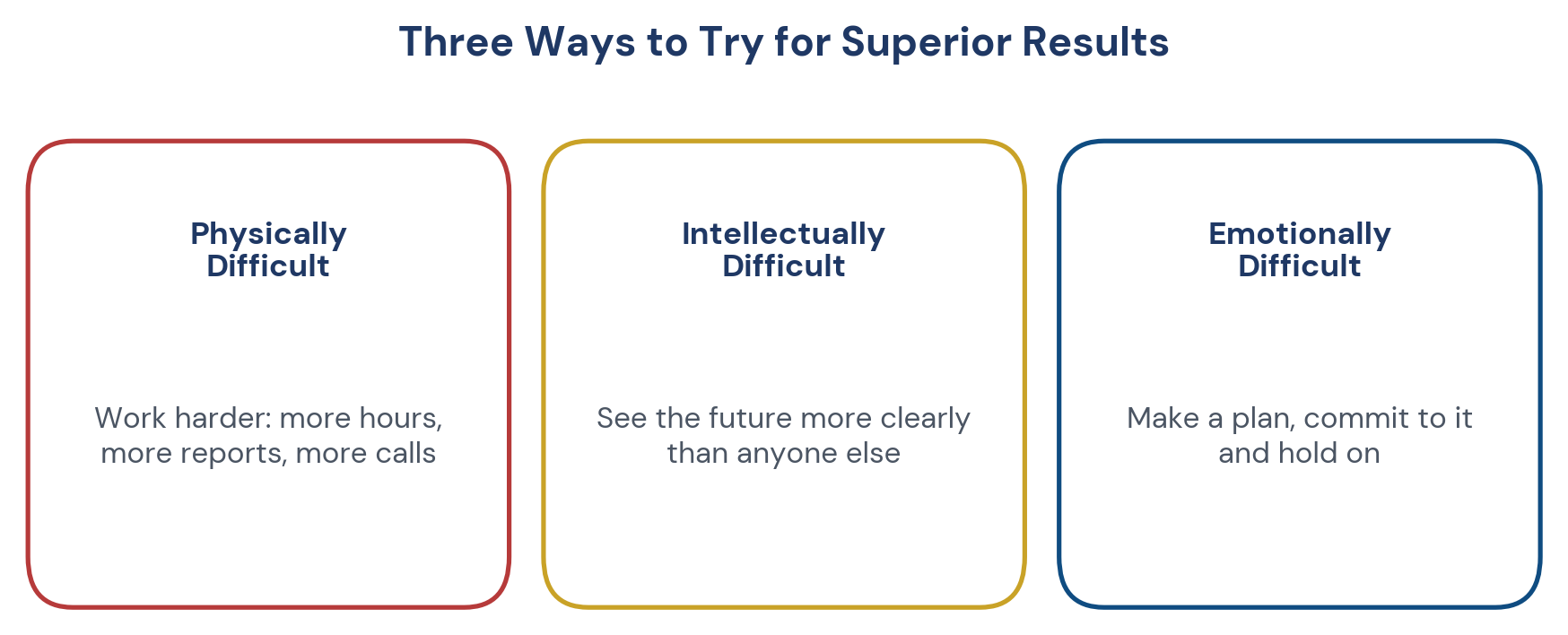 Figure 3. Ellis's three ways to try for superior results.
- "Most of the crowd is deeply involved in the physically difficult way of beating the market. They come to the office earlier; they stay later. They read a larger number of reports more rapidly. They go to more breakfast meetings and more luncheon meetings and more dinner meetings. They carry huge briefcases home at night. What they do not recognize is that so is almost everyone else."
Ellis describing the rat race. Everyone is working hard. Hard work is not the edge. Hard work is the entry ticket. The edge is something else.
- "Being incapable of doing the intellectually difficult, and reluctant about the physically difficult, I have set about the emotionally difficult approach to investing. Work out the long-term investment policy that is truly right for you. Commit to it. And here is the emotionally difficult part — hold on."
Ellis's confession. He is not a genius. He is not a workhorse. He is just someone who made a plan and stuck to it. That sounds easy. It is the hardest thing in investing.
- "When your friends turn to you and say, 'Wow! Have I got an opportunity for you! This is a great time to buy!' be absolutely uninterested. And when they turn to you and say, 'Oh, Lord, this is it. It is going to be one hell of a crash. Get out now while you can!' you must simply be not interested, absolutely sound asleep."
This is the master class. The crowd is always wrong at the extremes. Your friends are the crowd. When they are excited, sell. When they are terrified, buy. And when they are neither, hold on.
- "It requires no great genius and no great brawn, but it works."
The final verdict on the emotionally difficult path. You do not need to be smart. You do not need to be strong. You need to be steady. That is enough.
Charles Merrill: The Founder
- "We are going to provide facts, ungarnished with advice."
From the mission statement of Merrill Lynch, dated May 26, 1940, and included as an excerpt in the anthology. Charles A. Merrill and E.A. Pierce wrote this to their partners and managers. They promised to put the public's interest first. They promised to eliminate frills. They promised that their representatives would offer no advice and circulate no hot tips. They understood that the customer's interest and the firm's interest are the same thing in the long run.
- "We have a job to do of reestablishing faith in the security market as a place for sound investment. We are not going to wait for someone else to start it."
From the same 1940 mission statement. Written in the aftermath of the Great Depression, when faith in markets had been destroyed. Merrill understood that trust is not given. It is earned. And earning it requires action, not words.
The Thread That Connects All Fifty
Read through these quotes again. You will notice a pattern. The greatest investors are not the smartest. They are not the hardest working. They are the most disciplined. They have a plan. They stick to the plan. They ignore the noise. They buy when there is blood in the streets. They sell when there is euphoria in the air. They hold when there is nothing to do.
That is the wisdom of the anthology. It is not complicated. It is not easy. But it works.
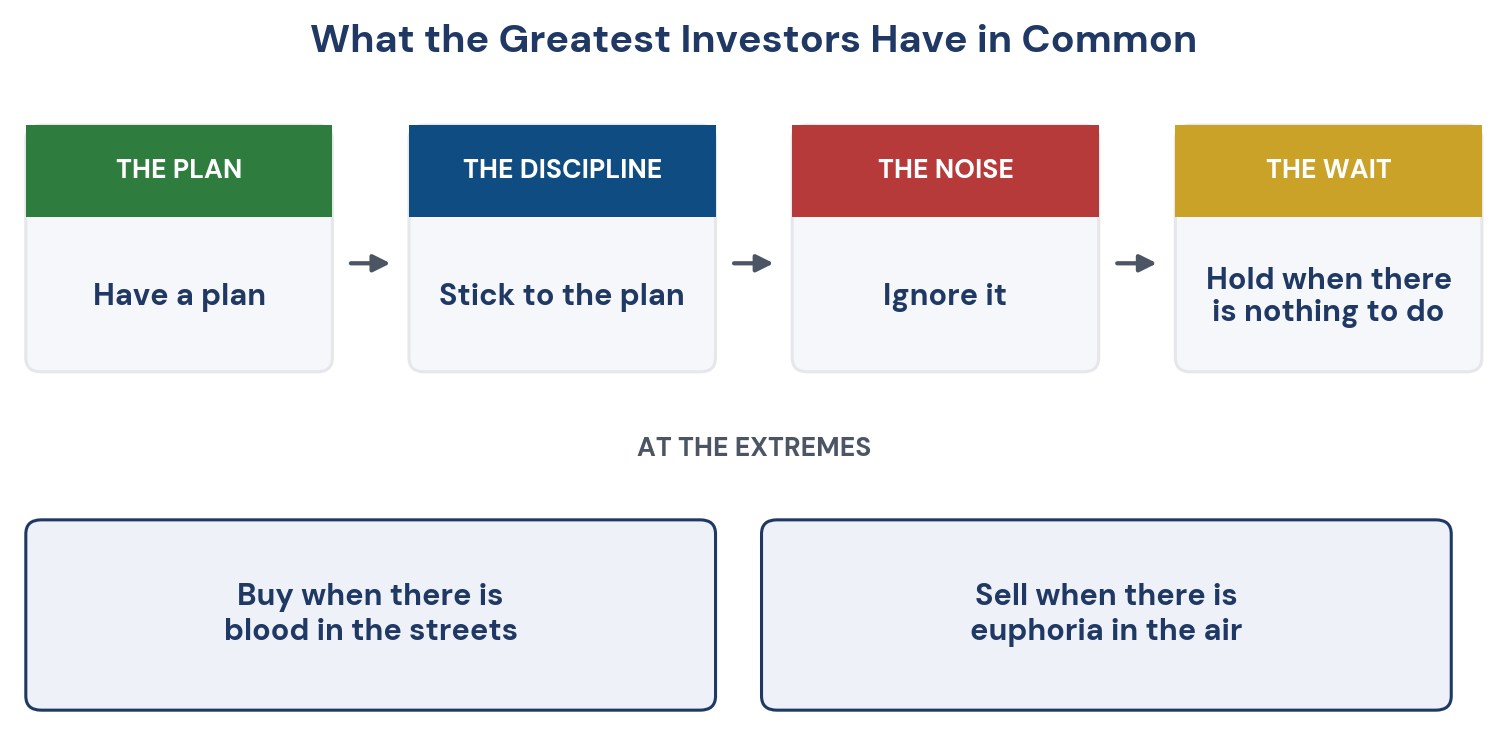 Figure 4. What the greatest investors have in common.
What We Are Doing With This Wisdom
We hold forty percent cash. That is the emotionally difficult path described by Ellis. Our friends think we are missing opportunities. They are probably right in the short term. We do not care about the short term.
We buy Japanese semiconductor equipment companies slowly, on pullbacks. That is the Templeton path. We are doing something different from the majority. The majority is chasing American AI stocks. We are accumulating Japanese industrial companies.
We short American semiconductors through bearish ETFs. That is the skepticism of Zeikel and the courage of Young. We are betting against the crowd. It is uncomfortable. It is supposed to be uncomfortable.
We hold our value positions in financials, healthcare, and software. That is the patience of Fisher and the discipline of Ellis. We bought when these sectors were hated. We will hold until the fundamentals change or a better opportunity appears.
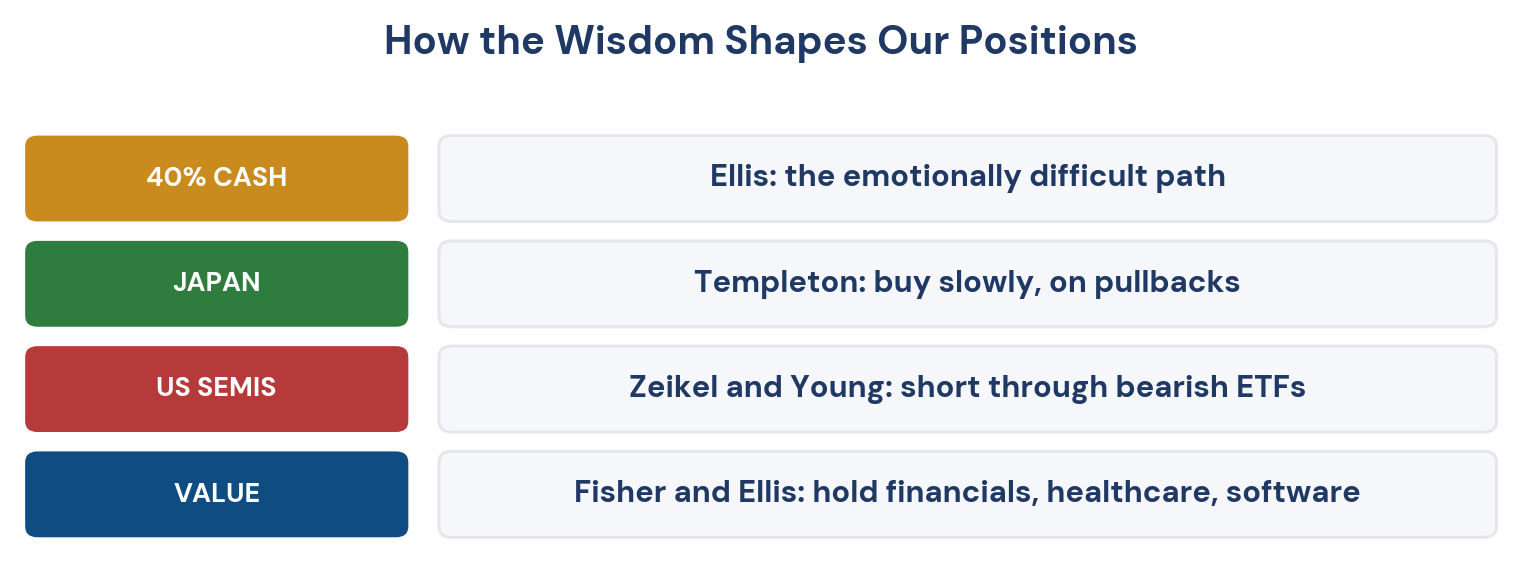 Figure 5. How the wisdom shapes our positions.
We are not selling. We are not panicking. We are not chasing. We are sitting. That is the hardest thing. That is the emotionally difficult path. That is the path that works.
Sincerely,
Bull Bear Bust
DISCLAIMER This newsletter is published for informational and educational purposes only. Nothing contained herein constitutes investment advice, a solicitation, or a recommendation to buy or sell any financial instrument. All investment involves risk, including the loss of principal. Past commentary does not guarantee future results. Any views expressed are those of the author as of the date of publication and are subject to change without notice. Please consult a licensed financial advisor before making any investment decisions. |