Equities · Education
The Complete Livermore: 100 Quotes from the Greatest Speculator Who Ever Lived
It Never Was My Thinking. It Always Was My Sitting Tight.
Bull, Bear, Bust · 2 September 2026 · 21 min read
Dear Client,
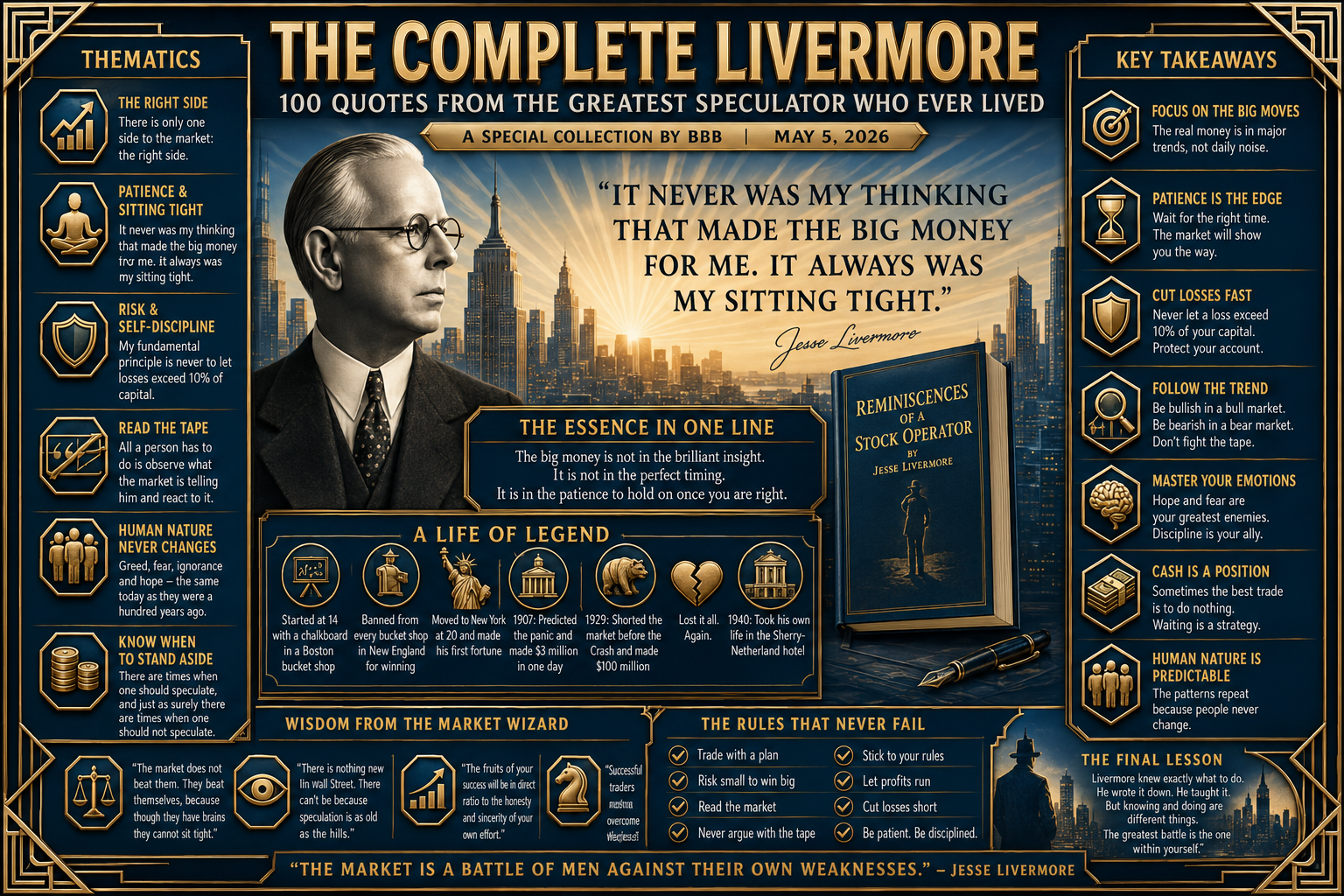
There have been richer men. There have been longer careers. There have been more respectable reputations. But there has never been a pure speculator who saw the tape more clearly than Jesse Lauriston Livermore.
He started at fourteen, keeping quotes on a chalkboard in a Boston bucket shop. He was banned from every bucket shop in New England for winning too consistently. He moved to New York at twenty and made his first fortune. He lost it. He made another. He lost that too. In 1907, he correctly predicted the panic and made three million dollars in a single day. J.P. Morgan himself sent an envoy to ask him to stop shorting.
In 1929, at the peak of his powers, he shorted the market before the Great Crash and made one hundred million dollars — roughly two billion dollars in today's money. He was the king of Wall Street.
And then he lost it all. Again. In 1940, he took his own life in the cloakroom of the Sherry-Netherland hotel.
The tragedy of Livermore is not that he failed. The tragedy is that he knew exactly what he should have done. He wrote it down. He taught it to anyone who would listen. But knowing and doing are different things. That is the final lesson of his life.
What follows are one hundred quotes from Reminiscences of a Stock Operator and How to Trade in Stocks. They are not just words. They are the operating system of the greatest speculator who ever lived. Read them. Learn them. And if you can follow even a fraction of them, you will be better than most.
KEY POINTS A quick-read snapshot of this newsletter's commentary
▸ There have been richer men and longer careers, but there has never been a pure speculator who saw the tape more clearly than Jesse Lauriston Livermore. ▸ In 1907, he correctly predicted the panic and made three million dollars in a single day. In 1929, he shorted the market before the Great Crash and made one hundred million dollars. And then he lost it all again. ▸ The tragedy of Livermore is not that he failed. The tragedy is that he knew exactly what he should have done. But knowing and doing are different things. ▸ "It never was my thinking that made the big money for me. It always was my sitting tight." The big money is in the patience to hold on once you are right. ▸ Never argue with the market, and never let losses exceed 10% of capital. ▸ The inability to control one's emotions is the real enemy of speculators. The successful trader has to reverse his natural impulses: instead of hoping he must fear, and instead of fearing he must hope. ▸ Wait for the key point, enter near the start of a trend, and hold cash until all the factors align. ▸ We hold forty percent cash, we hold our Japanese semiconductor equipment positions and we hold our short semiconductor positions. We are sitting tight. |
The Essence in One Line
Before we begin, let me give you the single sentence that captures everything Livermore ever learned. Everything else is commentary.
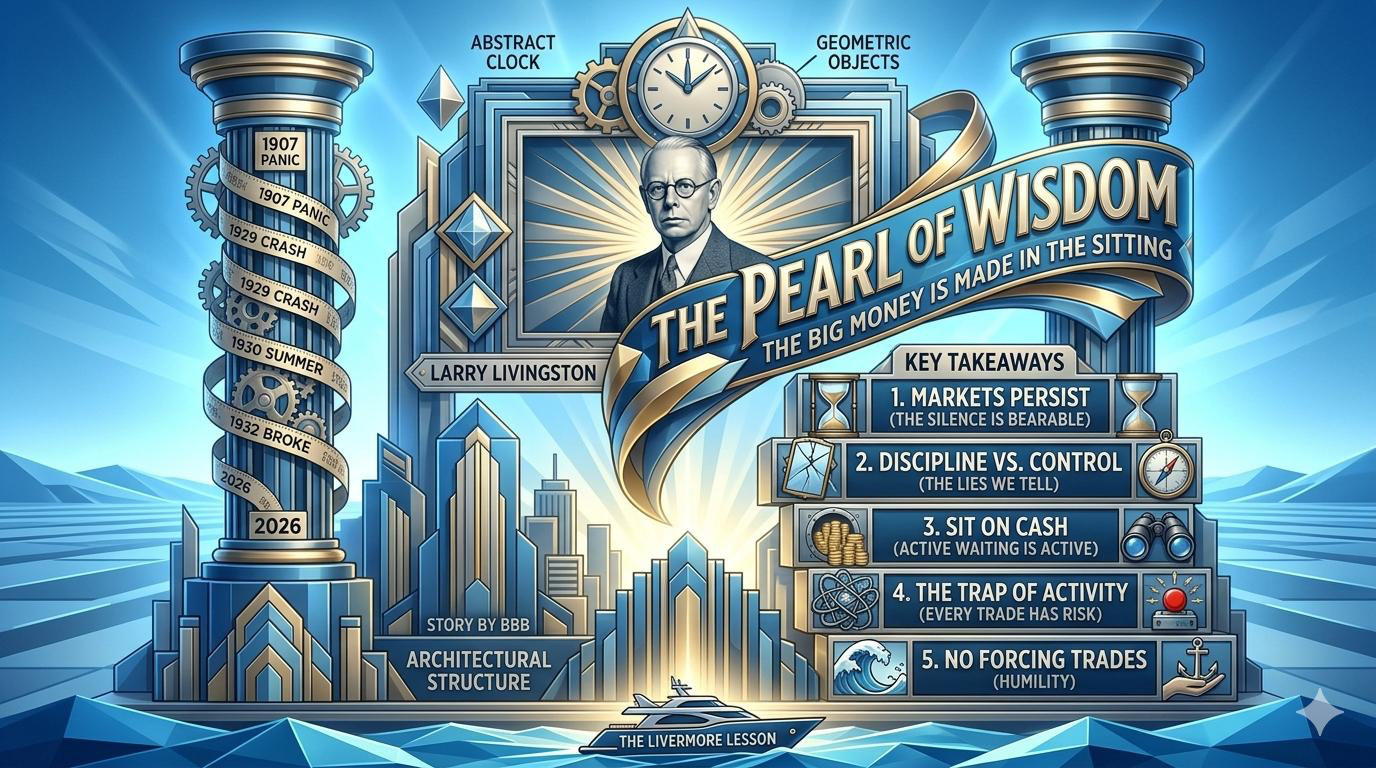
"It never was my thinking that made the big money for me. It always was my sitting tight."
This is the pearl. The big money is not in the brilliant insight. It is not in the perfect timing. It is in the patience to hold on once you are right. Livermore knew many men who were right at exactly the right time. They bought at the bottom. They sold at the top. And they made no real money because they could not sit tight.
Part One: The Philosophy of the Right Side
- "There is only one side to the stock market; and it is not the bull side or the bear side, but the right side."
- "It takes a man a long time to learn all the lessons of all his mistakes."
- "Wall Street never changes because human nature never changes."
- "There is nothing new in Wall Street. There can't be because speculation is as old as the hills. Whatever happens in the stock market today has happened before and will happen again."
- "I think the clearest summing up of the whole thing was expressed by Thomas F. Woodlock when he declared: 'The principles of successful stock speculation are based on the supposition that people will continue in the future to make the mistakes that they have made in the past.'"
- "The market does not beat them. They beat themselves, because though they have brains they cannot sit tight."
- "All through time, people have basically acted and reacted the same way in the market as a result of: greed, fear, ignorance, and hope. That is why the numerical formations and patterns recur on a constant basis."
- "The game of speculation is the most uniformly fascinating game in the world. But it is not a game for the stupid, the mentally lazy, the person of inferior emotional balance, or the get-rich-quick adventurer. They will die poor."
- "I have been in the speculative game ever since I was fourteen. It is all I have ever done. I think I know what I am talking about. And the conclusion that I have reached after nearly thirty years of constant trading, both on a shoestring and with millions of dollars back of me, is this: A man may beat a stock or a group at a certain time, but no man living can beat the stock market!"
- "All a person needs to do is observe what the market is telling him and evaluate it."
Part Two: The Art of Sitting Tight
- "It never was my thinking that made the big money for me. It always was my sitting. Got that? My sitting tight! It is no trick at all to be right on the market. You always find lots of early bulls in bull markets and early bears in bear markets. I've known many men who were right at exactly the right time, and began buying or selling stocks when prices were at the very level which should show the greatest profit. And their experience invariably matched mine that is, they made no real money out of it. Men who can both be right and sit tight are uncommon. I found it one of the hardest things to learn. But it is only after a stock operator has firmly grasped this that he can make big money. It is literally true that millions come easier to a trader after he knows how to trade than hundreds did in the days of his ignorance."
- "It is not the idea that makes money, but the quiet wait."
- "The speculator who insists on trying to profit from daily minor movements will never be in a position to take advantage of the next important change marketwise when it occurs."
- "Experience has proved to me that the real money made in speculating has been in commitments in a stock or commodity showing a profit right from the start."
- "If you have timed the movement correctly, your first commitment will show you a profit at the start."
- "One of the most helpful things that anybody can learn is to give up trying to catch the last eighth or the first. These two are the most expensive eighths in the world. They have cost stock traders, in the aggregate, enough millions of dollars to build a concrete highway across the continent."
- "The fruits of your success will be in direct ratio to the honesty and sincerity of your own effort in keeping your own records, doing your own thinking, and reaching your own conclusions."
- "There are times when one should speculate, and just as surely there are times when one should not speculate. There is a very true adage: 'You can beat a horse race, but you can't beat the races.' So it is with market operations. There are times when money can be made investing and speculating in stocks, but money cannot consistently be made trading every day or every week during the year."
- "Trading is not something you do every day. People who think they have to trade all the time ignore one condition, which is that trading needs a reason, and it has to be an objective and appropriate reason."
- "Rome was not built in a day. Truly significant trends do not end in a day or a week. It takes time to go through their logical process."
Part Three: The Rules of Self-Discipline
- "One of the primary rules is that one should never permit speculative ventures to run into investments."
- "Never argue with the market. Never make a play you can't afford. Never give way to irrational exuberance."
- "I have long since learned, as all should learn, not to make excuses when wrong. Just admit it and try to profit by it."
- "The market will tell the speculator when he is wrong, because he is losing money. When he first realized he is wrong is the time to clear out, take his losses, try to keep smiling, study the record to determine the cause of his error, and await the next big opportunity."
- "My fundamental principle is never to let losses exceed 10% of capital."
- "If, under certain circumstances, I buy a stock that I am bullish on but it does not perform as I had hoped, this is sufficient evidence for me to sell the stock."
- "I have proposed my 10% rule — if my loss in a trade exceeds 10%, I immediately liquidate."
- "Set your own rules and stick to them; never argue with the market."
- "You must adhere to the rules you set for yourself — do not deceive yourself, do not delay, do not wait!"
- "The predicament that inexperienced speculators often find themselves in is overcommitting to each position. Why? Because everyone feels the urge to trade. It goes against human nature to allocate too much to a single trade."
Part Four: Hope, Fear, and the Enemy Within
- "I think that the inability to control one's emotions is the real enemy of speculators. Fear and greed are always there, and they are hidden in our hearts. They wait outside the market to jump into the market to perform and wait for the opportunity to make a big profit."
- "The two main emotions in the stock market are hope and fear — hope is often caused by greed, and fear is often caused by ignorance."
- "When the market goes your way you become fearful that the next day will take away your profit, and you get out — too soon. Fear keeps you from making as much money as you ought to. The successful trader has to fight these two deep-seated instincts. He has to reverse what you might call his natural impulses. Instead of hoping he must fear; instead of fearing he must hope. He must fear that his loss may develop into a much bigger loss, and hope that his profit may become a big profit. It is absolutely wrong to gamble in stocks the way the average man does."
- "Hope is essential for human survival, but hope is the same as its cousins on the stock market — ignorance, greed, fear, and distorted reason. Hope covers up the facts, but the stock market only recognizes the facts."
- "When speculating, if the market goes against you, you hope that every day is the last day — and if you don't follow hope, you will lose more than you should. When the market goes your way, you are afraid that tomorrow will take away all your profits, so you exit — too quickly."
- "Successful traders must overcome these two deep-rooted instincts. He must change what you can call natural impulses. When he is hopeful, he should actually be afraid, and when he is afraid, he should be hopeful."
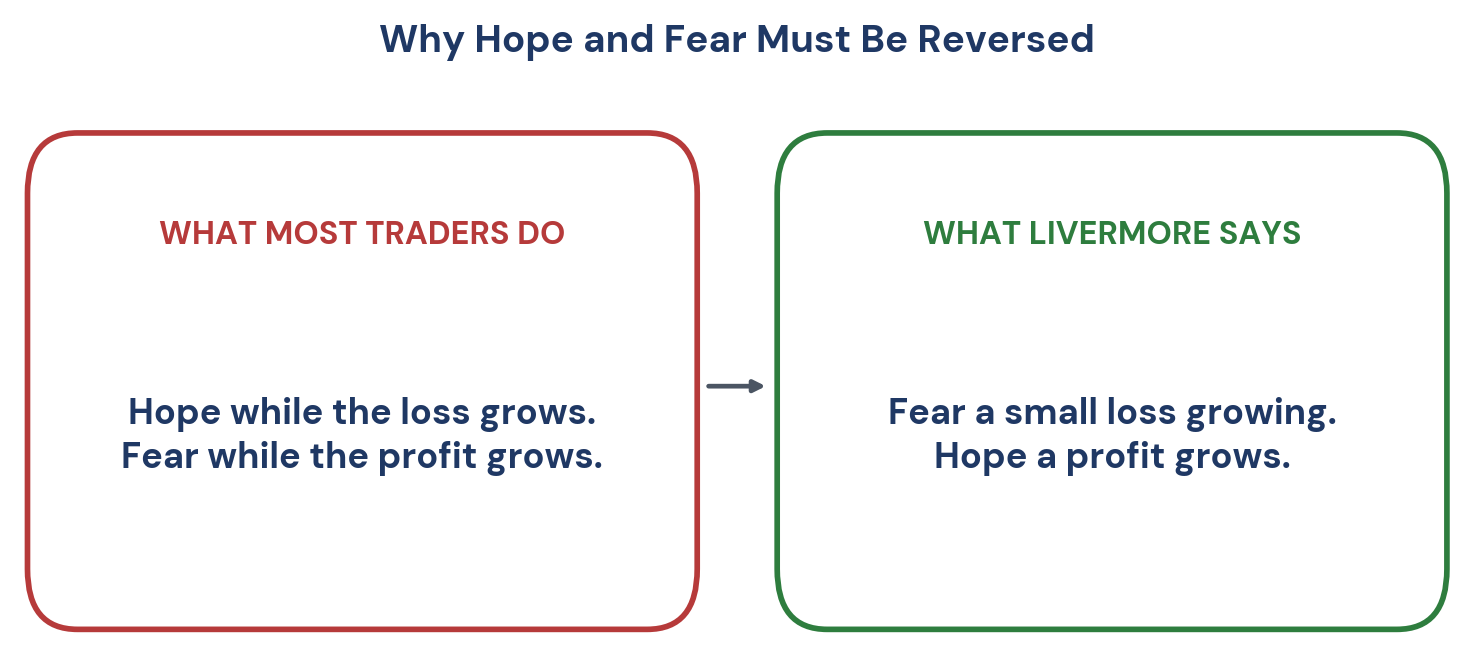 Figure 1. Livermore's rule for hope and fear.
- "If an investor has no self-discipline, no clear strategy, and no simple and feasible plan, he will fall into the trap of emotions. Because a speculator without a plan is like a general without a strategy."
- "I realized a long time ago that the stock market is never dull. It is designed to fool most people most of the time."
- "Right is right, and wrong is wrong. Only do the right thing and don't add to the mistakes."
- "Without faith in his own judgment no man can go very far in this game."
Part Five: Reading the Tape and Following the Trend
- "After forming a definite opinion with respect to a certain stock or stocks — do not be too anxious to get into it. Wait and watch the action of that stock or stocks marketwise."
- "The most important thing before entering a trade is to determine whether the line of least resistance is consistent with your trading direction."
- "Read the market. It is an important part of this game. It is also important to start at the right time, and it is equally important to stick to your position. However, my biggest discovery is that one must study and evaluate the overall situation in order to predict future possibilities."
- "I no longer gamble blindly and no longer care about how to master the skills of operation. Instead, I care about winning my own success through hard work and clear thinking."
- "It is obvious that one should be bullish in a bull market and bearish in a bear market. It sounds funny, but I had to deeply understand this general principle before I could put it into practice. It took me a long time to learn to trade according to these principles."
- "When I see a danger signal, I don't argue with it. I get out of the way! A few days later, if everything still looks good, I come back. I think of it this way. If I'm walking along the railroad track and see a train coming at me at 60 miles an hour, I'll jump off the track and let the train pass, instead of foolishly standing there. After it passes, I can always get back on the track if I want to."
- "I never fight individuals or speculative cliques. I merely differ in opinion — that is, my reading of basic indicators. What playwrights call battles of business are merely tests of vision. I try to stick to facts, and govern my actions accordingly. When I do not see facts early and clearly, I am wrong. It always costs me money to be wrong."
- "There is the stock's behaviour — actions that enable you to foresee where it is heading. If the stock doesn't act right don't touch it; because, being unable to tell what is wrong, you cannot tell which way it is going. No diagnosis, no prognosis. No prognosis, no profit."
- "All a person has to do is observe what the market is telling him and react to it. The answer is in the market itself. The challenge is to correctly interpret the presented facts."
- "In the course of time new leaders will come to the front; some of the old leaders will be dropped. It will always be that way as long as there is a stock market."
Part Six: The Lessons of Losing
- "There is nothing like losing all you have in the world for teaching you what not to do."
- "And when you know what not to do in order not to lose money, you begin to learn what to do in order to win."
- "Slow as my progress seems now, I suppose I learned as fast as I possibly could, considering that I was making money on balance. If I had lost oftener perhaps it might have spurred me to more continuous study. I certainly would have had more mistakes to spot. But I am not sure of the exact value of losing, for if I had lost more I would have lacked the money to test out the improvements in my methods of trading."
- "To learn that a man can make foolish plays for no reason whatever was a valuable lesson. It cost me millions to learn that another dangerous enemy to a trader is his susceptibility to the urgings of a magnetic personality when plausibly expressed by a brilliant mind. It has always seemed to me, however, that I might have learned my lesson quite as well if the cost had only been one million. But Fate does not always let you fix the tuition fee. She delivers the educational wallop and presents her own bill, knowing you have to pay it, no matter what the amount may be. Having learned what folly I was capable of I closed that particular incident."
- "My losses were entirely due to lack of patience. I didn't patiently wait for the right time to support the views and plans I had already formed."
- "I didn't have as many interesting experiences as you might imagine. I mean, the process of learning how to speculate does not seem very dramatic at this distance. I went broke several times, and that is never pleasant, but the way I lost money is the way everybody loses money who loses money in Wall Street. Speculation is a hard and trying business, and a speculator must be on the job all the time or he'll soon have no job to be on."
- "Strangely, the trouble most speculators encounter is something inside themselves that prevents them from having the courage to close their positions when they should. They hesitate and, in their hesitation, watch the market move many points in a direction unfavorable to them."
- "I also found that no one is immune from the danger of making foolish operations. If a person operates foolishly, he will pay the price for his foolishness."
- "Trading is a confrontation between rationality and emotion. Trading requires a rational plan."
- "Maintain a calm mindset; do not argue with the facts, do not cling to hope when there is none, and do not dispute with the ticker tape, because the ticker tape is always right — there is no room for hope, guesswork, fear, greed, or emotion in speculation."
Part Seven: The Key Points of Entry and Exit
- "A key to my later trading theory is: only trade at key points. As long as I am patient and trade at key points, I can always make money. I also think that the largest part of a stock's market situation often occurs in the last two weeks or longer of this market situation."
- "My experience is that if I don't enter the market near the starting point of a trend, I will never make much profit from that trend. The reason is that I miss the profit cushion."
- "The market will timely send you a signal of when to enter the market. It is equally certain that the market will also timely send you a signal to exit — if you wait patiently."
- "With this kind of courage and patience, he can calmly watch the market change and hold his position in the face of the small declines or rebounds that are bound to occur before the end of this trend."
- "At many times, Livermore was holding cash and waiting until the right market situation appeared. Many of his successes were due to his ability to hold cash and wait patiently until the right market situation appeared before him."
- "When the market situation appeared and there were many opportunities favorable to him, it was only at this time, and only at this time, that he struck out like a cobra."
- "You have to be patient and wait for the right key point to appear and the right trading opportunity. Patience, patience, and more patience. This is his secret to grasping the opportunity and achieving success."
- "Speculators should buy stocks in several installments, and each time only a certain proportion should be purchased."
- "I act on instinct. In reality, it is not instinct but a subconscious accumulation of years of battling in the stock market."
- "If I lose my position, I lose the certainty of a big killing. It is the big swing that brings you big money."
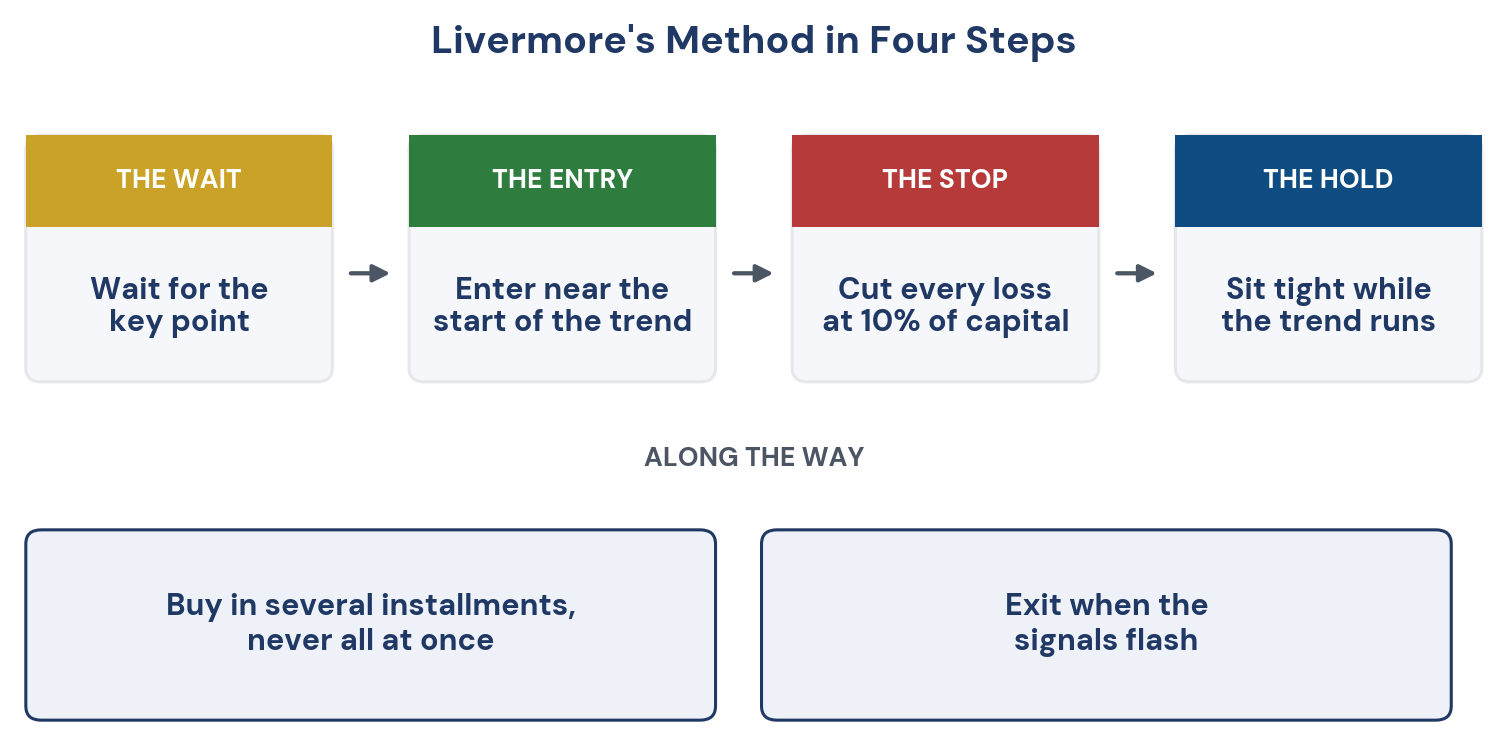 Figure 2. Livermore's method, step by step.
Part Eight: The Psychology of the Crowd
- "Market movements repeat themselves because human nature does not change."
- "Greed, fear, ignorance, and hope — these are the same today as they were a hundred years ago."
- "The crowd is always wrong at the extremes. When everyone is bullish, be cautious. When everyone is bearish, be greedy."
- "Speculation is the hardest work in the world, combined with the hardest nerves."
- "The average man is never told how to speculate correctly. He is told how to get rich quick. That is why he stays poor."
Part Nine: The Wisdom of Experience
- "I think I know what I am talking about. And the conclusion that I have reached after nearly thirty years of constant trading, both on a shoestring and with millions of dollars back of me, is this: A man may beat a stock or a group at a certain time, but no man living can beat the stock market!"
- "That is about all I have learned — to study general conditions, to take a position and stick to it. I can wait without a twinge of impatience."
- "One of the lessons I learned early in the stock market is that there is nothing new on Wall Street because speculation is as old as the hills."
- "I think what I really can't remember is when and how it happens. The way I remember these facts is the way I use my experience."
- "Fundamentally, because of greed and fear, ignorance and hope, people always behave in the same way — this is why those numerical patterns and trends always repeat themselves unchanged."
Part Ten: The Final Wisdom
- "The market will tell the speculator when he is wrong, because he is losing money."
- "When he first realized he is wrong is the time to clear out, take his losses, try to keep smiling, study the record to determine the cause of his error, and await the next big opportunity. It is the net result over a period of time in which he is interested."
- "In addition to trying to figure out how to make money, traders must also try to avoid losing money. Knowing what to do is almost as important as knowing what not to do."
- "A stock operator must fight many expensive enemies in his heart."
- "The reason why predicting the market is so difficult is human nature. Taming and conquering human nature is the most difficult task."
- "Choosing the right time carefully is very important. If you rush, you will pay the price."
- "I didn't know that 15 years later, some things would let me wait for two whole weeks and watch the stock I was very bullish on rise 30 points before I felt it was safe to buy."
- "Volume reveals truth. Surges near peaks signal distribution — not opportunity."
- "Escape danger first. Re-enter only when safe."
- "Only large volatility yields large profits."
Part Eleven: The Legacy
- "The successful trader has to fight these two deep-seated instincts. He has to reverse what you might call his natural impulses."
- "Instead of hoping he must fear; instead of fearing he must hope."
- "He must fear that his loss may develop into a much bigger loss, and hope that his profit may become a big profit."
- "It is absolutely wrong to gamble in stocks the way the average man does."
- "Markets don't beat traders — traders beat themselves. Master patience, process, and perspective. Study the market. Take positions. Hold on."
- "Wall Street never changes because human nature never changes. Recognize these emotions — they're your compass for spotting recurring patterns."
- "Trade only when the market speaks. Never force trades. Action demands objective reasons."
- "Holding cash until all factors align is strategic strength."
- "Enter near trend beginnings; exit when signals flash."
- "Patience isn't passive — it's positioning."
The One Line That Captures the Essence
If you remember nothing else from these one hundred quotes, remember this single sentence. It is the closest thing to a universal truth that Livermore ever discovered.
"It never was my thinking that made the big money for me. It always was my sitting tight."
The greatest speculator in American history — a man who made and lost four fortunes, who called the 1907 panic and the 1929 crash, who traded his way from a chalkboard in Boston to a private office with sixty tickers — this man tells you that the secret is not brilliant thinking. It is sitting. Waiting. Holding. Doing nothing when there is nothing to do.
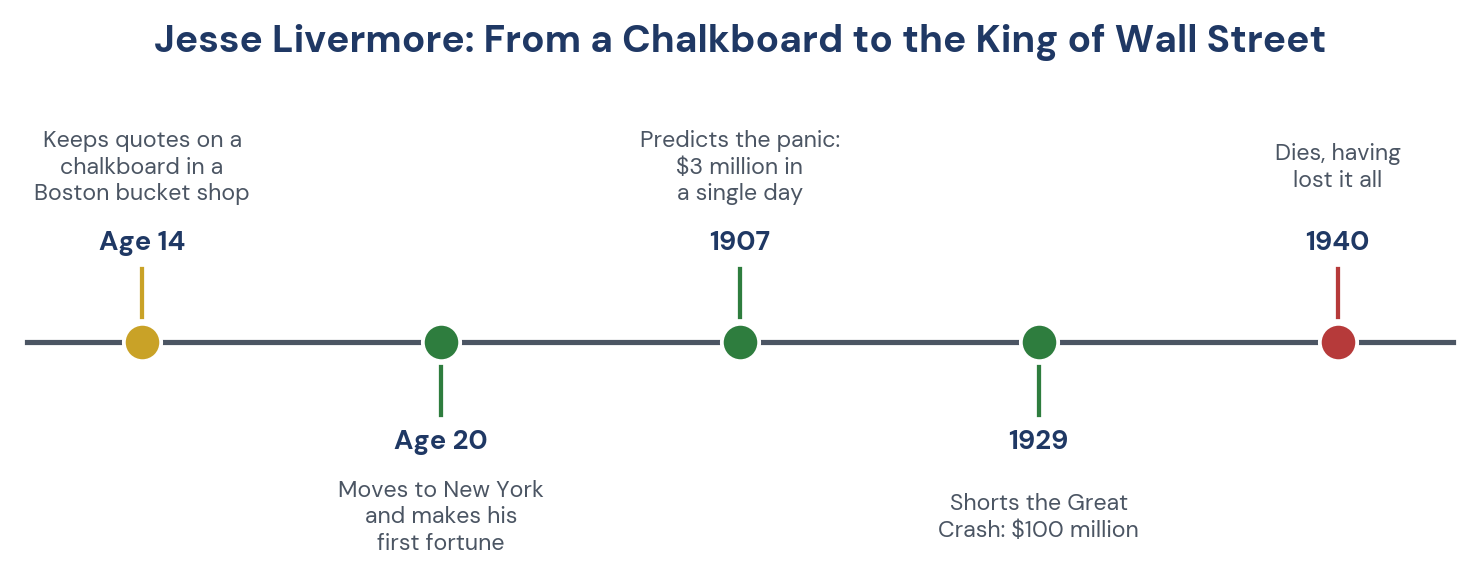 Figure 3. Livermore's life, from a Boston chalkboard to the king of Wall Street.
That is the lesson. That is the pearl. That is the legacy of Jesse Livermore.
What We Are Doing with This Wisdom
We hold forty percent cash. Not because we are bearish. Because the market has not yet given us a clear signal to deploy it. We are sitting tight.
We hold our Japanese semiconductor equipment positions. Not because we are in love with them. Because the primary trend is intact and the reasons we bought them have not changed. We are sitting tight.
We hold our short semiconductor positions. Not because we enjoy being contrary. Because the tape told us the AI euphoria was overdone. We are sitting tight.
We do not trade every day. We do not trade every week. We trade when the market gives us a reason. The rest of the time, we sit.
Livermore taught us that the big money is not in the thinking. It is in the sitting. We are listening.
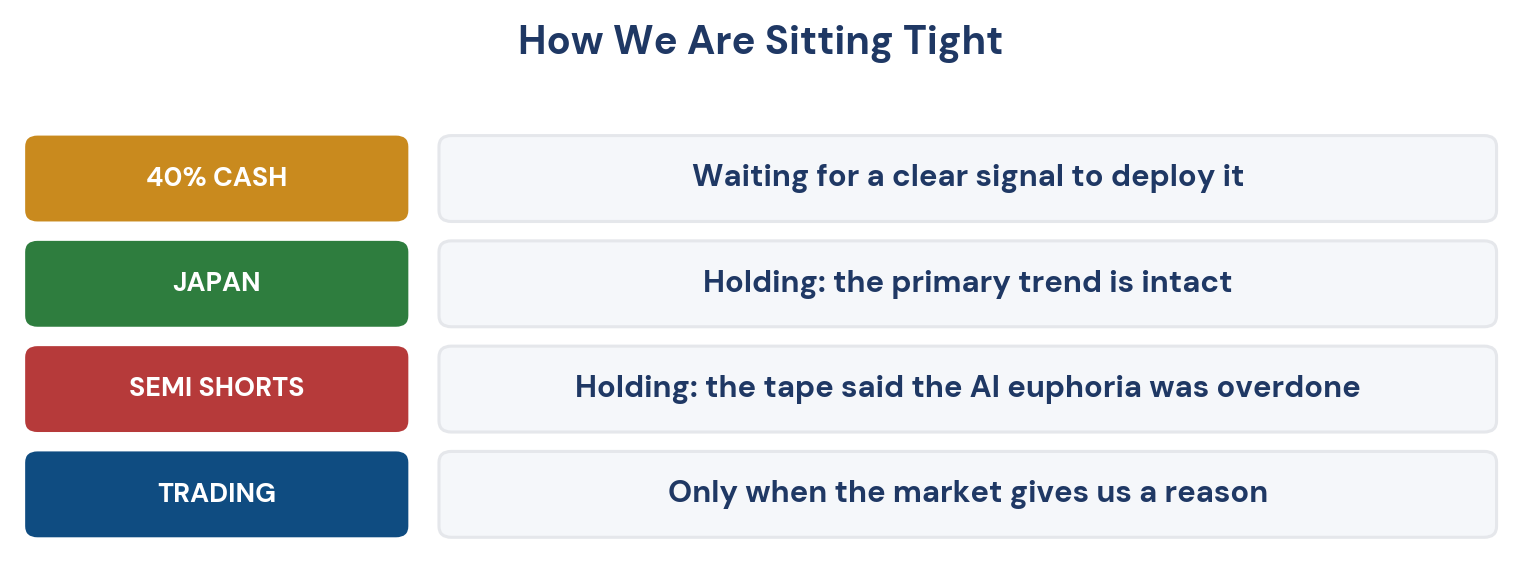 Figure 4. How we are sitting tight.
Sincerely,
Bull Bear Bust
DISCLAIMER This newsletter is published for informational and educational purposes only. Nothing contained herein constitutes investment advice, a solicitation, or a recommendation to buy or sell any financial instrument. All investment involves risk, including the loss of principal. Past commentary does not guarantee future results. Any views expressed are those of the author as of the date of publication and are subject to change without notice. Please consult a licensed financial advisor before making any investment decisions. |