Education · Research
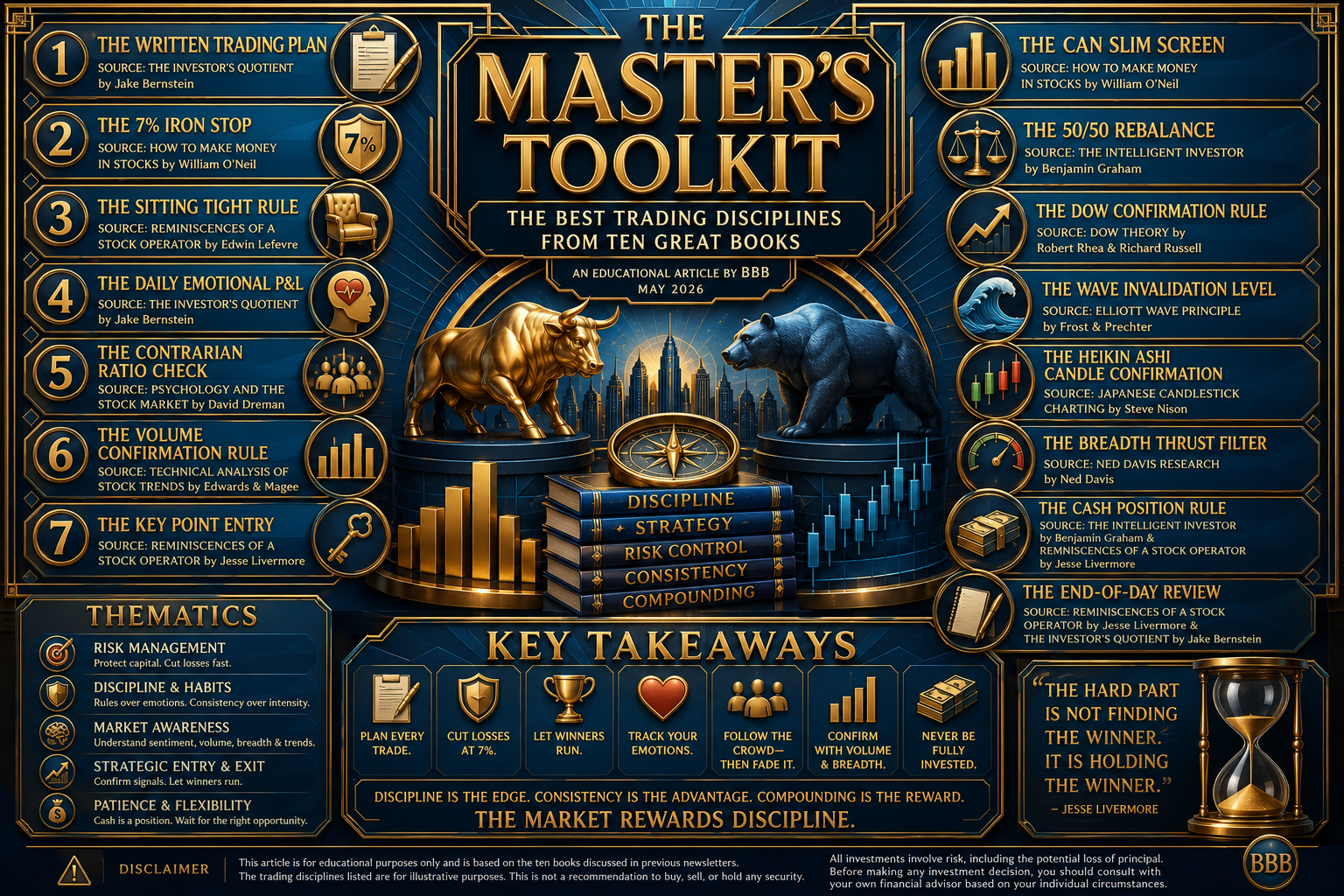
The Master's Toolkit
The Best Trading Disciplines from Ten Great Books
Bull, Bear, Bust · 20 September 2026 · 14 min read
Dear Client,
Over the past weeks, we have walked through ten of the most important investment books ever written. We have studied Livermore's tape reading and O'Neil's CAN SLIM. We have absorbed Edwards and Magee's patterns and Nison's candles. We have wrestled with Bernstein's psychology, Dreman's contrarianism, and Prechter's waves. We have stood on the shoulders of Graham, Dow, and Ned Davis.
But knowledge without action is worthless. Wisdom without discipline is just information. So let us now extract the best trading disciplines from all ten books — the specific, actionable practices that separate the professionals from the amateurs, the survivors from the blown-up, the compounders from the gamblers.
These are not theories. These are disciplines. They are habits. They are rules that you can write down, tape to your screen, and follow every single day. They will not make you perfect. But they will give you an edge. And in a game where the house always wins, an edge is everything.
KEY POINTS A quick-read snapshot of this newsletter's commentary
▸ Fifteen trading disciplines drawn from ten great books, each a rule you can write down and follow every day. ▸ Write a plan before every trade: what you are buying, why, your entry, your stop and your target. ▸ Sell every stock at a seven percent loss from your purchase price, as O'Neil taught. ▸ Once you hold a winner, sit tight until the tape tells you to get out. ▸ Check sentiment extremes: be cautious when more than 60% of investors are bullish and interested when more than 60% are bearish. ▸ Confirm every move: a breakout needs volume at least 40% above average, and a rally needs breadth behind it. ▸ Never be fully invested: hold at least 20% cash at all times, and rebalance a 50/50 stock and bond split once a year. ▸ You do not need all fifteen; even three or four will give you an edge over the vast majority of investors. |
Discipline One: The Written Trading Plan
Source: The Investor's Quotient by Jake Bernstein
Before you place a single trade, you must write down your plan. Not in your head. Not on a spreadsheet. On paper, with a pen, in words that another person could understand.
Your plan must answer five questions. What are you buying? Why are you buying it? Where is your entry? Where is your stop? Where is your target? If you cannot answer all five questions in thirty seconds, you are not ready to trade.
The discipline is this: no trade without a written plan. None. Not one. Not even a small one. The act of writing forces clarity. It forces specificity. It forces you to confront the trade before you are in it, when your judgment is clear, not after you are in it, when your judgment is clouded by hope and fear.
Bernstein's clients who followed this single rule improved their win rates by more than twenty percent. Not because the rule predicted anything. Because the rule prevented stupid trades.
Discipline Two: The 7% Iron Stop
Source: How to Make Money in Stocks by William O'Neil
O'Neil was ruthless about cutting losses. He backtested thousands of stocks over decades. He found that the single biggest difference between winners and losers was not their entry. It was their exit. Winners let profits run. Losers cut losses fast. And the line between fast and slow was seven percent.
The discipline is this: sell every stock, no exceptions, at a seven percent loss from your purchase price. Not seven and a half percent. Not eight percent. Not "just wait until tomorrow." Seven percent.
O'Neil understood that a seven percent loss is a scratch. It is a small wound that heals quickly. A fifteen percent loss is a fracture. A twenty-five percent loss is a break. A fifty percent loss is a career-ender. The seven percent stop is the line between scratching and breaking.
The hardest part of this discipline is not the math. It is the psychology. When your stock is down seven percent, every instinct will tell you to wait. To hope. To give it one more day. Those instincts are wrong. They are the instincts of the amateur. The professional sells first and asks questions later.
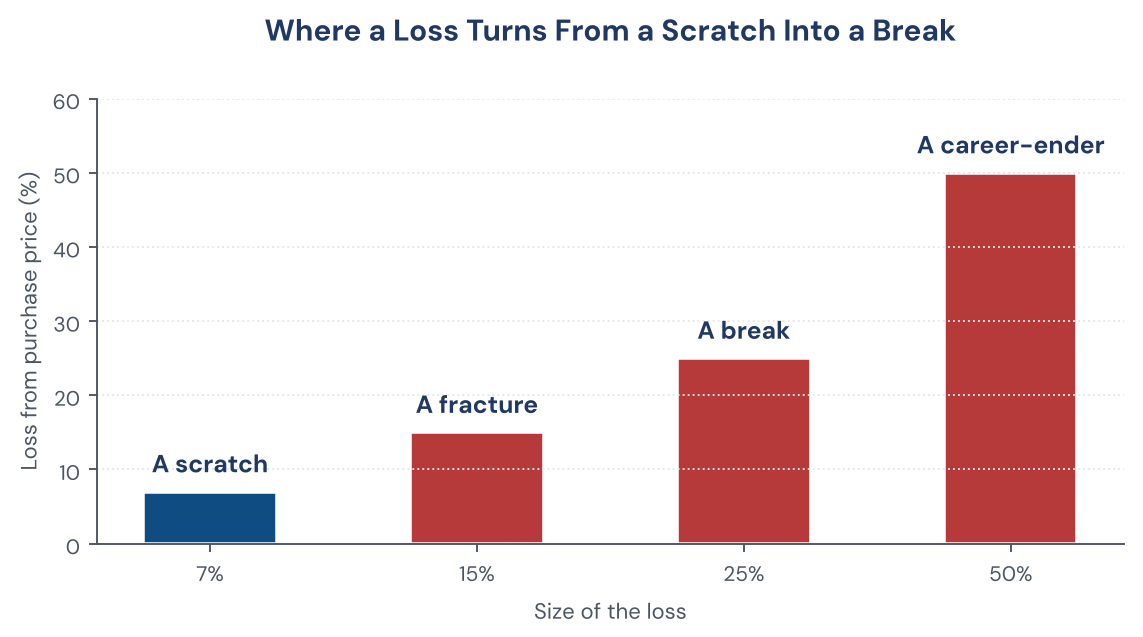
Figure 1. Where a loss from the purchase price turns from a scratch into a break.
Discipline Three: The Sitting Tight Rule
Source: Reminiscences of a Stock Operator by Edwin Lefevre
Jesse Livermore made and lost four fortunes. He was right more often than almost any trader who ever lived. And he learned that being right was not enough. The big money was not in the thinking. It was in the sitting.
The discipline is this: once you have a winning position, do nothing. Do not take partial profits because you are nervous. Do not move your stop up because you are greedy. Do not add to the position because you are excited. Sit. Tight.
The hardest part of trading is not finding the winner. It is holding the winner. The market will test you. It will shake you. It will take your twenty percent gain down to ten percent, then back to twenty, then down to fifteen. Every dip will feel like the end. Most of them will not be.
Livermore's rule was simple: sit tight until the tape tells you to get out. Not your gut. Not the news. Not your friends. The tape.
Discipline Four: The Daily Emotional P&L
Source: The Investor's Quotient by Jake Bernstein
Bernstein required his clients to keep two journals. The first was a standard trade log. The second was an emotional profit and loss statement. Next to every trade, the client recorded how they felt before, during, and after.
The discipline is this: after every trading day, record your emotional state on a scale of one to ten. Then review your trades. Are your losing trades correlated with low emotional scores? Are your winning trades correlated with high emotional scores? For Bernstein's clients, the answer was almost always yes.
Once you see the pattern, you can act on it. If you are emotional, do not trade. If you are calm, trade. It sounds simple. It is simple. It is also rare. Most investors never track their emotions, so they never see the pattern, so they never change.
Discipline Five: The Contrarian Ratio Check
Source: Psychology and the Stock Market by David Dreman
Dreman spent decades studying the behavior of crowds. He found that the crowd is right during the middle of a trend and wrong at both ends. When the crowd is most optimistic, the top is near. When the crowd is most pessimistic, the bottom is near.
The discipline is this: before you make a significant commitment, check the sentiment data. The American Association of Individual Investors survey, the put-call ratio, the volatility index, the advisory sentiment — these are not predictions. They are measurements of the crowd's position. And the crowd's position is your signal.
If more than sixty percent of investors are bullish, be cautious. If more than sixty percent are bearish, be interested. If the extremes are even wider — seventy-five percent bullish, eighty percent bearish — act. The crowd is wrong at the extremes. That is your edge.
Discipline Six: The Volume Confirmation Rule
Source: Technical Analysis of Stock Trends by Edwards and Magee
Edwards and Magee were obsessive about volume. They believed that price without volume was a rumor. Price with volume was a fact. Volume is the footprint of the big money. Follow the footprints.
The discipline is this: never buy a breakout unless volume is at least forty percent above the average. Never sell a breakdown unless volume is at least forty percent above the average. If the move is not confirmed by volume, it is not a move. It is noise.
O'Neil made this rule even more specific. He required volume on the breakout day to be fifty to one hundred percent above the fifty-day average. That was the signature of institutional accumulation. That was the signal to buy.
The rule applies to exits as well. If a stock is breaking down on heavy volume, get out. If it is breaking down on light volume, wait. The volume tells you whether the move is real or just a test.
Discipline Seven: The Key Point Entry
Source: Reminiscences of a Stock Operator by Jesse Livermore
Livermore learned that entries matter. Not because timing the exact bottom is possible, but because entering at the right point creates a cushion. If you enter at the exact moment the trend asserts itself, you are never sitting through a large loss. Your risk is small. Your confidence is high.
The discipline is this: do not enter a trade until the market tells you it is time. Do not anticipate. Do not front-run. Wait for the price to confirm your thesis. Then act.
Livermore called these "key points." They are the moments when the line of least resistance changes. They are the moments when a consolidation breaks out, when a moving average turns, when a swing high is exceeded. They are not predictions. They are confirmations. And they are the only times Livermore entered a trade.
Discipline Eight: The CAN SLIM Screen
Source: How to Make Money in Stocks by William O'Neil
O'Neil's CAN SLIM system is not a single indicator. It is a seven-filter screen. Every stock must pass all seven tests before O'Neil would buy it.
The discipline is this: do not buy any stock until you have run it through all seven filters. Current quarterly earnings must be up at least twenty-five percent. Annual earnings must have grown at least twenty-five percent for each of the last three years. The stock must be near a new high. It must have institutional sponsorship. It must be a leader in its group. And the broad market must be in an uptrend.
This discipline is powerful because it eliminates almost every stock. That is the point. O'Neil was not looking for reasons to buy. He was looking for reasons to reject. The stocks that survived the screen were rare. And they were the ones that made the big money.
Discipline Nine: The 50/50 Rebalance
Source: The Intelligent Investor by Benjamin Graham
Graham did not believe in market timing. He did not believe in stock picking for most people. He believed in a simple discipline: keep your portfolio balanced between stocks and bonds.
The discipline is this: start with fifty percent stocks and fifty percent bonds. Rebalance once per year. If stocks have gone up, sell some and buy bonds. If stocks have gone down, sell some bonds and buy stocks. That is it. No predictions. No forecasts. No economic analysis.
Graham understood that this simple discipline forces you to buy low and sell high. Not perfectly. Not dramatically. But consistently, year after year. And consistency is the engine of compounding.
Discipline Ten: The Dow Confirmation Rule
Source: Dow Theory by Robert Rhea and Richard Russell
Dow taught that no single average tells the truth. The industrials and the transports must confirm each other. If one makes a new high and the other does not, the trend is suspect. If one makes a new low and the other does not, the trend is suspect.
The discipline is this: never trust a signal from a single index or a single stock. Look for confirmation across related markets. Are the transports confirming the industrials? Are small caps confirming large caps? Are foreign markets confirming the US market?
Russell added a volume filter to this rule. He required ninety percent up-volume days to confirm a new bull market. Without that volume explosion, he stayed in cash. The discipline saved his clients from the 1987 crash, the 2000 crash, and the 2008 crash.
Discipline Eleven: The Wave Invalidation Level
Source: Elliott Wave Principle by Frost and Prechter
Elliott wave analysis is complex. But the discipline at its core is simple. Every count has an invalidation level. That is the price at which you would know your count is wrong.
The discipline is this: before you enter a trade based on any pattern, identify the level that would prove you wrong. For a head and shoulders bottom, it is the neckline. For a triangle breakout, it is the opposite side of the triangle. For an Elliott wave impulse, it is the beginning of wave one.
Once you have identified your invalidation level, place your stop just below it. Then forget about the pattern. The stop will protect you. If you are wrong, you lose a small amount. If you are right, you ride the trend.
Discipline Twelve: The Heikin Ashi Candle Confirmation
Source: Japanese Candlestick Charting by Steve Nison
Nison spent his career studying the ancient Japanese rice traders. He found that individual candles contain immense information. But the information is noisy. Heikin Ashi candles smooth the noise.
The discipline is this: do not trade a candle pattern on standard charts. Wait for confirmation on Heikin Ashi. The Hammer on a standard chart is a signal. The Hammer on a Heikin Ashi chart is a much stronger signal. The Bullish Engulfing on a standard chart is interesting. The Bullish Engulfing on a Heikin Ashi chart is actionable.
Nison's backtests showed that patterns on Heikin Ashi charts had success rates twenty to thirty percentage points higher than the same patterns on standard charts. The smoothing filters out the false signals. It lets the true signal through.
Discipline Thirteen: The Breadth Thrust Filter
Source: Ned Davis Research by Ned Davis
Ned Davis spent fifty years building quantitative models. His most powerful signal is the breadth thrust. When more than ninety percent of stocks trade above their fifty-day moving average on volume that is also above ninety percent of the average, a powerful move is underway.
The discipline is this: do not trust a market rally unless it is confirmed by breadth. If the indices are making new highs but fewer than seventy percent of stocks are participating, the rally is narrow and vulnerable. If the indices are making new lows but fewer than thirty percent of stocks are participating, the decline is exhausted.
Davis's data showed that breadth thrusts preceded eighteen-month bull markets with eighty percent accuracy. The signal does not come often. When it comes, act.
Discipline Fourteen: The Cash Position Rule
Source: The Intelligent Investor by Benjamin Graham and Reminiscences of a Stock Operator by Jesse Livermore
Both Graham and Livermore understood that cash is not a failure. Cash is a position. Cash is optionality. Cash is the dry powder that lets you buy when everyone else is selling.
The discipline is this: never be fully invested. Hold at least twenty percent cash at all times. In dangerous markets, hold more. In extreme markets, hold much more.
Livermore learned this the hard way. He made fortunes and lost them because he could not sit on cash. Graham built his entire defensive strategy around the fifty-fifty stock-bond split, which is cash by another name. They both understood that the best opportunity is the one you have the capital to buy.
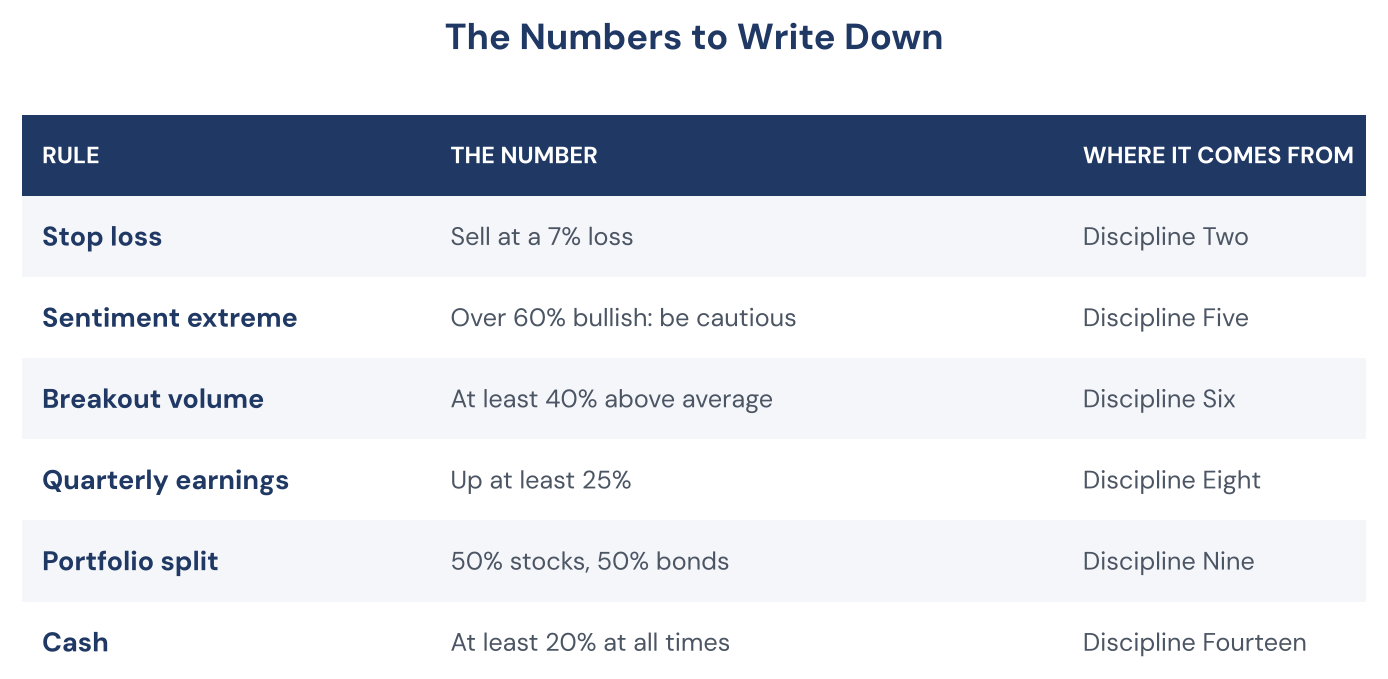
Figure 2. The numbers to write down, with the discipline each comes from.
Discipline Fifteen: The End-of-Day Review
Source: Reminiscences of a Stock Operator by Jesse Livermore and The Investor's Quotient by Jake Bernstein
Livermore reviewed his trades every evening. He did not celebrate his winners. He studied his losers. Bernstein added the emotional dimension. Livermore taught that the big money is in the sitting. But the sitting only works if you are sitting in the right trades.
The discipline is this: at the end of every trading day, review your open positions. Has your thesis changed? Is your stop still appropriate? Are you holding because the trade is working or because you are afraid to admit you were wrong?
Then review your closed trades. What did you do right? What did you do wrong? What emotion drove each decision? Write it down. Read it back. Learn from it.
This discipline takes fifteen minutes. Most investors will not do it. The ones who do will improve faster than the ones who do not.
The Master Summary: Fifteen Disciplines in One Paragraph
You do not need to follow all fifteen. Even following three or four will give you an edge over the vast majority of investors.
But if you want the core — the disciplines that appear in multiple books, endorsed by multiple masters — here they are. Write down your plan before every trade. Cut every loss at seven percent. Let your winners run. Track your emotions daily. Check the sentiment extremes. Confirm every move with volume and breadth. And never be fully invested.
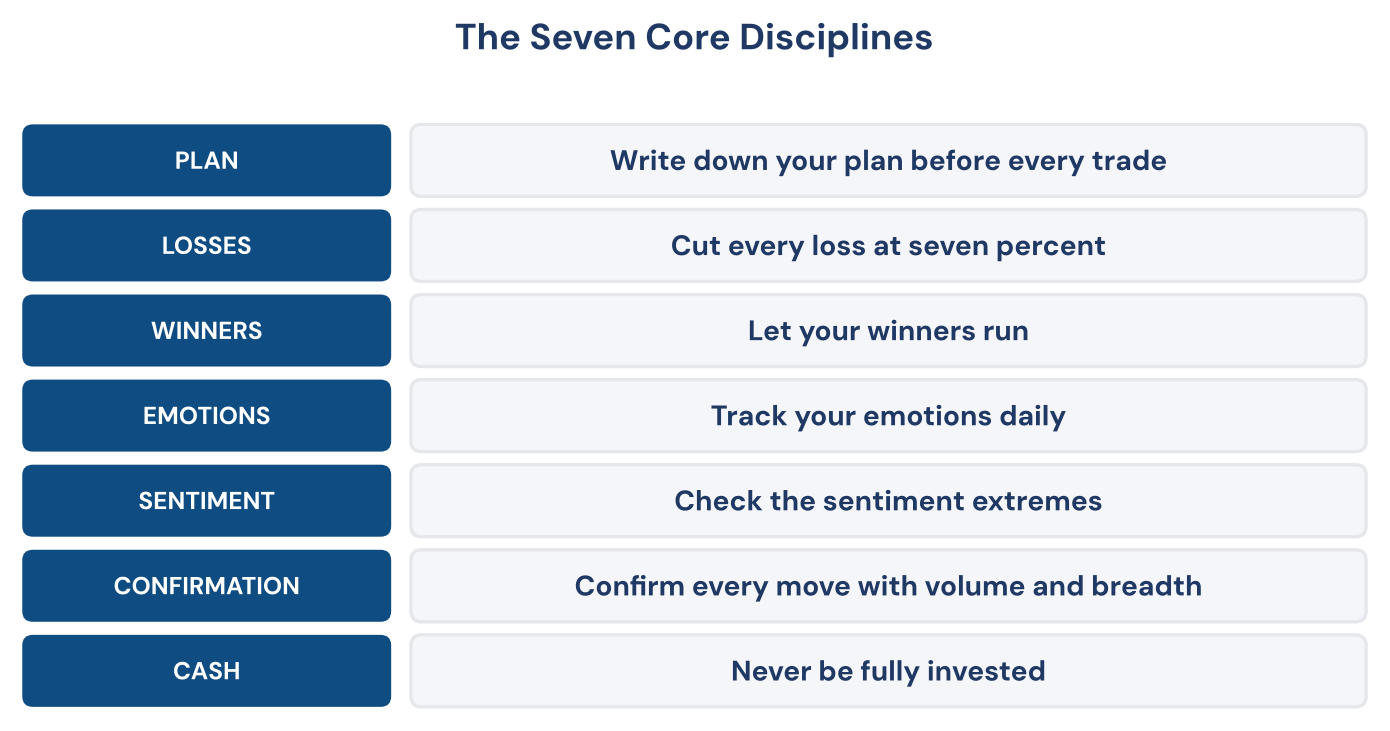
Figure 3. The seven core disciplines from the Master Summary.
These are not secrets. They are not complex. They are not even interesting. They are disciplines. They are habits. They are the difference between the investor who survives and the investor who does not.
The market does not reward intelligence. It rewards discipline. Be disciplined.
Sincerely,
Bull Bear Bust
DISCLAIMER This newsletter is published for informational and educational purposes only. Nothing contained herein constitutes investment advice, a solicitation, or a recommendation to buy or sell any financial instrument. All investment involves risk, including the loss of principal. Past commentary does not guarantee future results. Any views expressed are those of the author as of the date of publication and are subject to change without notice. Please consult a licensed financial advisor before making any investment decisions. |