China · Equities · Macro
The Quiet Pivot
Triggers for a New China Cycle
Bull, Bear, Bust · 20 April 2026 · 11 min read
Dear Client,
Something has shifted beneath the surface of China's markets. It is not dramatic. It is not accompanied by fireworks or grand announcements. But if you are watching closely, you can feel it: the first whiffs of a pivot. After years of despair, policy paralysis, and a K-shaped recovery that left most investors cold, a new cycle is beginning to stir.
This is not the China of 2020 — the breakneck growth, the property-fueled euphoria, the easy money. That China is gone, and it is not coming back. What is emerging is something different: a slower, more structural, more innovation-led economy that prioritizes quality over quantity and resilience over speed. For investors willing to look past the old narratives, this new cycle offers a set of opportunities unlike anything we have seen in years.
Let us walk through the triggers — economic, thematic, market, and psychological — that are aligning to launch this new cycle. We are not recommending anything. We are simply sharing what we see.
KEY POINTS A quick-read snapshot of this newsletter's commentary
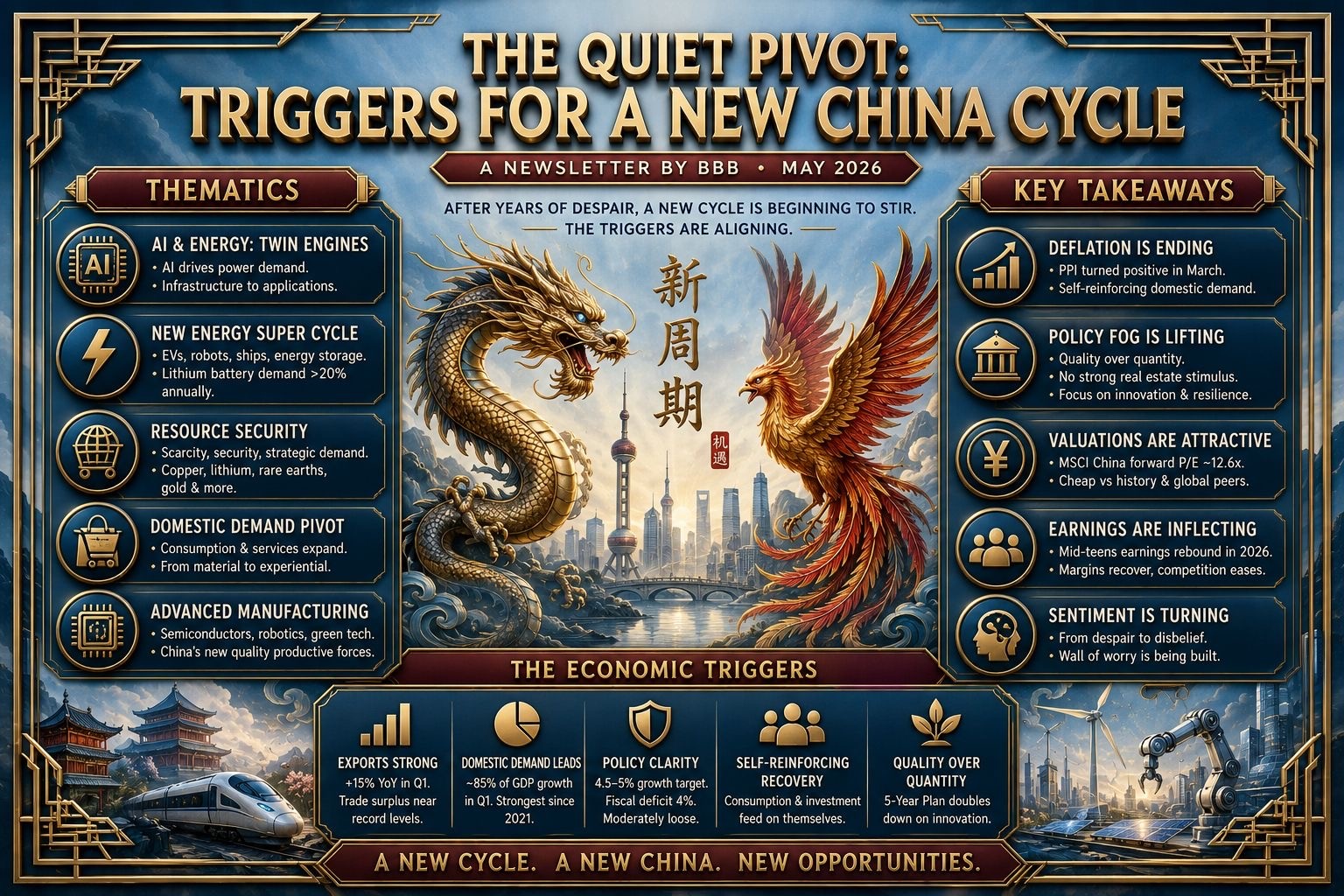
▸ A new cycle is beginning to stir in China after years of despair, policy paralysis and a K-shaped recovery. ▸ Deflation is ending: producer prices turned positive in March for the first time in more than three and a half years. ▸ First quarter exports rose 15% year over year, and domestic demand contributed nearly 85% of GDP growth. ▸ The 2026 National People's Congress lowered the growth target to 4.5 to 5% and held the fiscal deficit at 4% of GDP, with no strong real estate stimulus. ▸ AI and energy are the twin engines: lithium battery demand is growing more than 20% annually, and key resources are being repriced on scarcity, security and strategic demand. ▸ MSCI China trades at about 12.6 times forward earnings, global portfolios remain heavily underweight, and consensus points to a mid-teens earnings rebound in 2026. ▸ Sentiment has moved from despair to disbelief, which is the first stage of a new bull cycle. ▸ We are watching property stabilisation, the consumer willingness gauge (98.1, with 110 the next level), the AI application layer and geopolitics, including a potential Xi-Trump meeting in mid-May. |
The Economic Triggers: Green Shoots After the Long Winter
Deflation is ending. This is the most important economic trigger of all. Producer prices turned positive in March for the first time in more than three and a half years. This is not a minor footnote. Producer prices have historically led consumer prices in China, and their return to positive territory suggests that the deflationary spiral that haunted the economy for nearly four years is finally breaking.
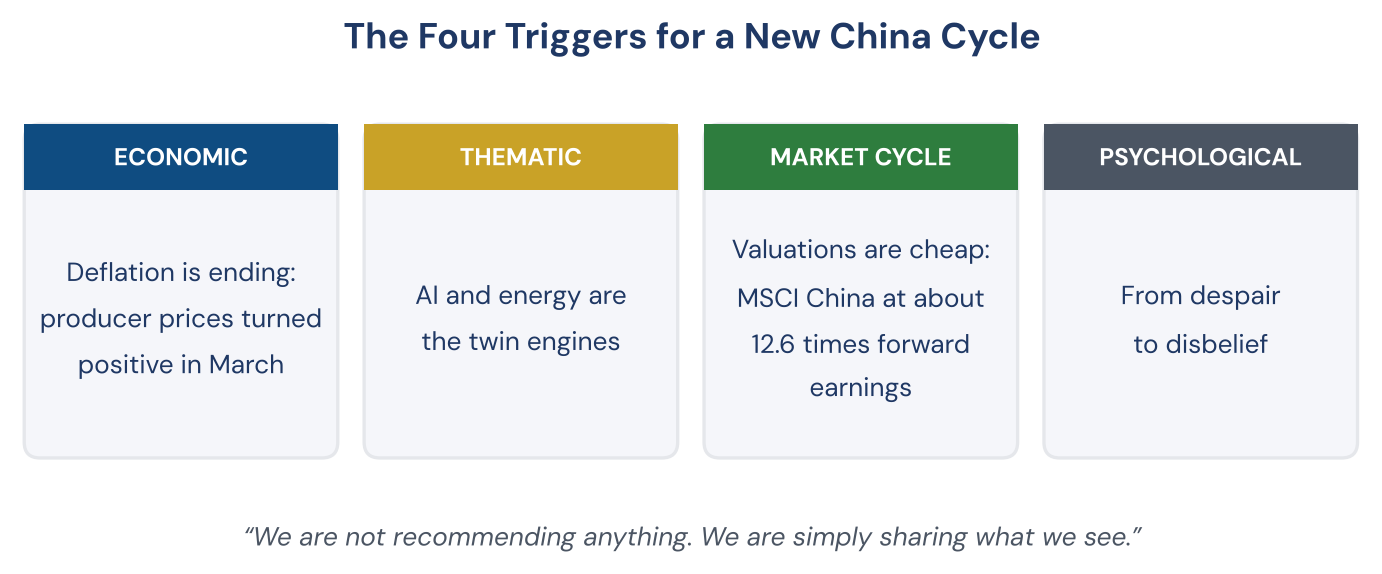
Figure 1. The four triggers for a new China cycle: economic, thematic, market and psychological.
The first quarter numbers tell the story. Exports rose 15 percent year over year, led by advanced manufacturing. The trade surplus remains near record levels. Domestic demand contributed nearly 85 percent of GDP growth in the first quarter — a stunning reversal from the export-dependent pattern of recent years. Domestic demand may have delivered its strongest contribution to growth since 2021.
This is not a stimulus-driven sugar high. The recovery in domestic demand has become self-reinforcing for the first time since 2021. Private consumption and business investment are beginning to feed on themselves, not on government subsidies. That is the difference between a cyclical bounce and a structural turn.
The policy fog is lifting. For years, the biggest risk in China was not economic — it was regulatory unpredictability. Surprise actions in tech, education, and property could undo months of confidence-building overnight. That risk has not disappeared, but it has diminished meaningfully.
The 2026 National People's Congress delivered a clear message: quality over quantity. The growth target was lowered to a range of 4.5 to 5 percent — a realistic acknowledgment that China is no longer chasing double-digit expansion. The fiscal deficit was held steady at 4 percent of GDP. Monetary policy remains "moderately loose" but not aggressive.
Crucially, there was no strong real estate stimulus. This is a feature, not a bug. Beijing has accepted that property will stabilize at lower levels and will not be the engine of growth it once was. The 15th Five-Year Plan is doubling down on "new quality productive forces" — AI, semiconductors, green energy, and advanced manufacturing. The old model is dead. The new model is being built.
The Thematic Triggers: Where the Money Is Flowing
AI and energy are the twin engines. This is the most important thematic shift to understand. Global strategists are now describing AI and energy as the "dual engines" driving the next phase of growth. The two are intimately connected: AI's explosive development is dramatically increasing electricity demand, which in turn is pushing the ceiling higher for new energy sources.
In China, this plays out across several fronts. Domestic AI capital expenditure is ramping up as hyperscalers build out their infrastructure. The "lobster" (OpenClaw) phenomenon — the rise of AI agents — marks a shift from AI infrastructure to AI applications. Domestic computing power construction is entering a stage of volume growth.
On the energy side, the story is even more compelling. The rapid expansion of electric vehicles, robots, electric trucks, and electric ships is driving lithium battery demand growth of more than 20 percent annually. At the same time, fixed-asset investment growth in the battery sector peaked in mid-2024 and has been slowing. The supply-demand balance is moving from improvement to potential shortage.
This is not a speculative narrative. It is grounded in industrial reality. Multiple Chinese battery leaders have passed international certifications and are beginning to scale overseas, opening second growth curves.
Resource security is the new investment lens. Geopolitical realignment and the AI supercycle are interacting to create what one strategist calls a "commodity-intensive global capex cycle". This is not the old commodities supercycle driven by Chinese urbanization. This is a different beast: supply-constrained, politically charged, and structurally persistent.
Key resources are being repriced through what analysts call the "three-S" framework: scarcity, security, and strategic demand. Copper, gold, lithium, rare earths, cobalt, tungsten, and chromium all fit this description. The distinguishing feature of this cycle is that supply is constrained not by economics but by policy and geopolitics. Many countries are now treating resources as tools of international leverage. That changes the duration and nature of the price cycle.
The domestic demand pivot is real. For years, investors heard about China's consumption story and saw little evidence. That is changing. The consumer goods trade-in program, financed through ultra-long special treasury bonds, generated over 500 billion yuan in sales and benefited nearly 70 million consumers as of mid-April.
The quality of this recovery matters. New energy vehicles accounted for nearly 60 percent of trade-in purchases. Smart appliances have displaced conventional ones. Service consumption — tourism, sports, elderly care — is expanding as consumers shift from material satisfaction to experiential consumption.
A consumer willingness gauge tracked by Wind climbed from 92.7 in December 2024 to 98.1 in February 2026. This is not yet euphoria. It is the slow, grinding improvement that precedes a genuine spending cycle.
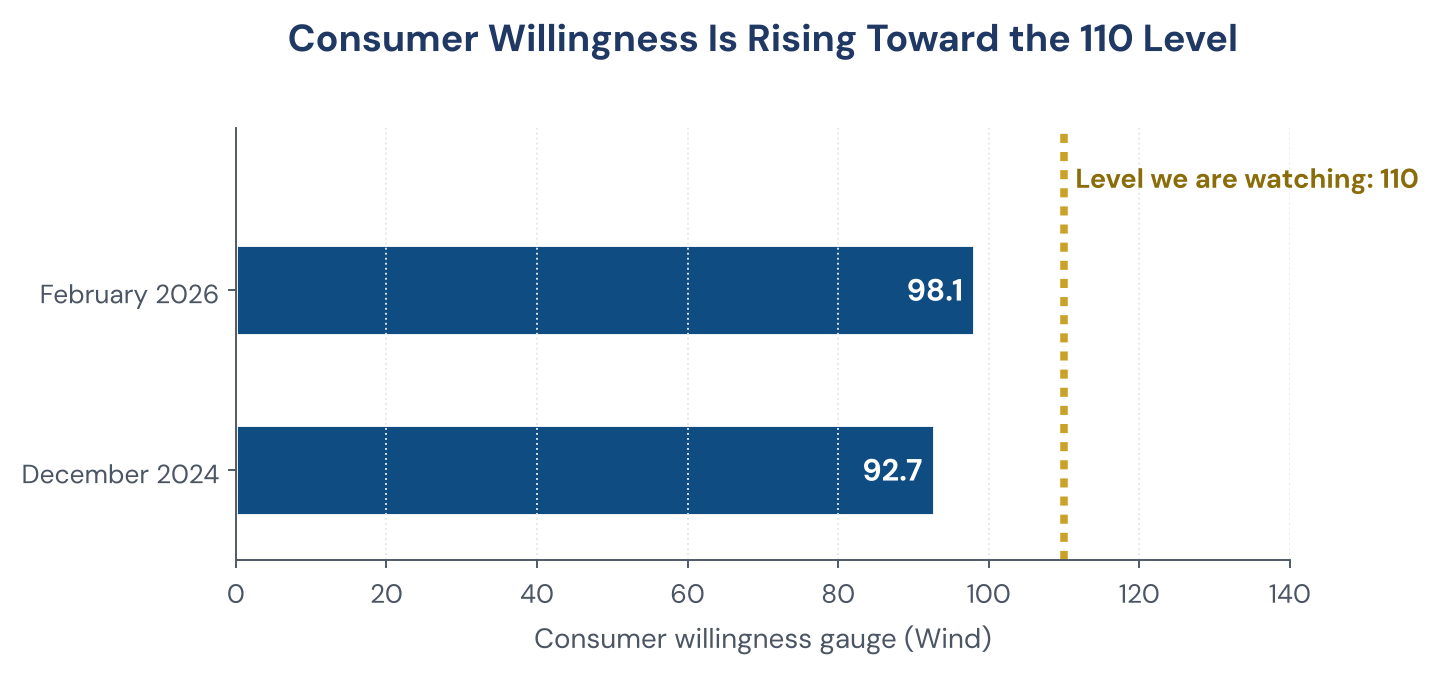
Figure 2. The consumer willingness gauge rose from 92.7 in December 2024 to 98.1 in February 2026.
The Market Cycle Triggers: Valuations, Flows, and Earnings
Valuations are cheap relative to history and the world. MSCI China trades on a forward price-to-earnings ratio of approximately 12.6 times — only slightly above its long-term average, even after a meaningful rally in 2025. Relative to Asia, China remains one of the cheaper large markets. Relative to developed markets, China is outright cheap.
Global portfolios remain heavily underweight China. This creates an asymmetry: it would not take much for sentiment or flows to turn meaningfully. Investors have stopped calling China "uninvestable." Expectations are low. Valuations are fair. That combination is often the starting point for the best investment cycles.
Earnings are quietly inflecting. For the broader market, consensus points to a mid-teens earnings rebound in 2026, led by consumer-facing sectors where competition has rationalized, margins have recovered, and market structure looks healthier. This recovery does not rely on heroic GDP assumptions. It reflects companies resetting, cutting wasteful price wars, and operating in a more realistic environment.
The property sector is slowly becoming less of a problem. Not a recovery — that ship has sailed — but a managed, orderly adjustment. Mortgage rates are down. Some inventory is being purchased by local governments. The sector is shrinking as a share of GDP, and that is healthy. The remaining drag on sentiment is understood and priced.
Flows are beginning to turn. With geopolitical uncertainty surging from the Middle East and elsewhere, long-term capital allocators are reviewing their positioning. China — less exposed to energy risks following years of electrification and renewable energy development — could prove valuable as a safe haven relative to other markets.
The renminbi is appreciating on a pro-cyclical basis, reflecting improving returns on investment and declining risk premia. This could enable US dollar-denominated earnings growth of Chinese corporates to outpace that of major developed markets for the first time since 2021. That would be a structural change in global asset allocation.
The Psychological Cycle: From Despair to Disbelief
The sentiment floor has been reached. For years, the dominant emotion toward China was despair. Not pessimism — despair. Pessimism is a trading signal. Despair is something deeper. It is the feeling that nothing will ever get better, that the problems are structural and permanent, that the best course is to simply stop looking.
That emotion has faded. Investors are not yet optimistic. They are not yet bullish. But they have stopped calling China uninvestable. The despair phase of the psychological cycle has run its course.
We are entering the disbelief phase. The disbelief phase is the first stage of a new bull cycle. It occurs when fundamentals improve but investors refuse to believe the improvement is real. Every green shoot is dismissed as a head fake. Every earnings beat is explained away as a one-off. Every policy announcement is read cynically.
This is precisely where we are with China today. The producer price index has turned positive. Domestic demand is self-reinforcing. Exports are robust. Earnings are recovering. Valuations are cheap. And the consensus remains skeptical. That is not a problem. That is an opportunity.
The wall of worry is being built. Bull markets climb walls of worry. China is building its wall now. The worries are real: property remains a drag, geopolitics are unpredictable, consumer confidence is fragile, and the risk of regulatory surprise has not vanished. These worries will not disappear. They will be climbed.
The transition from despair to disbelief to hope to optimism to euphoria takes years. We are at the beginning of that journey, not the end. The best returns in any cycle come in the early stages, when valuations are cheap and sentiment is skeptical. That is where China sits today.
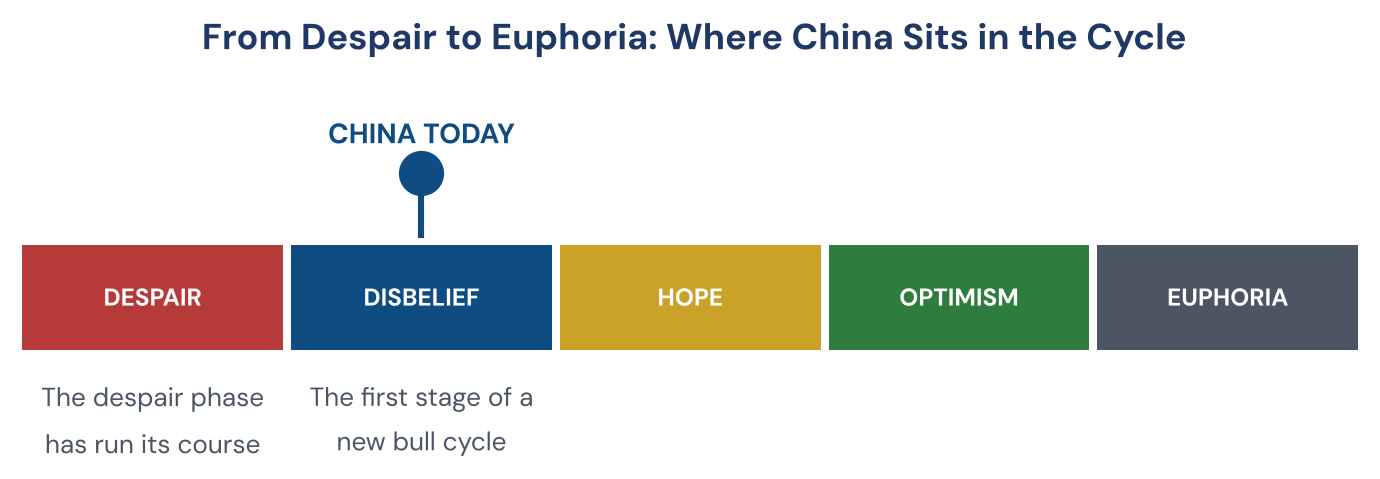
Figure 3. China sits at the start of the disbelief phase of the psychological cycle.
What We Are Watching as the Cycle Unfolds
The property sector's stabilization. We do not need a recovery. We need the drag to stop worsening. The signs are mixed but moving in the right direction. Mortgage rates are down. Local governments are purchasing inventory. The sector is shrinking as a share of GDP. An orderly adjustment is the best we can hope for, and it appears to be underway.
The consumer confidence recovery. The jump in the willingness gauge from 92.7 to 98.1 is meaningful. It is not yet transformative. The next leg — from 98 to 110 — would signal a genuine spending cycle. We are watching for that.
The AI application layer. The infrastructure build-out is happening. The question is whether applications will follow. The emergence of AI agents suggests they will. When applications scale, the second leg of the AI trade begins. That is when software and platforms outperform hardware.
Geopolitical noise. A potential Xi-Trump meeting in mid-May is worth watching. The US-China trade truce appears to be holding, and direct exports to the US are recovering from their 26 percent drop. De-escalation, not resolution, is the baseline. That is enough.
The Bottom Line
A new cycle in China is not guaranteed. The triggers we have outlined could fail to fire. Property could worsen. Consumer confidence could stall. Geopolitics could erupt. Regulatory surprises could return. These are real risks, and we do not dismiss them.
But the weight of evidence has shifted. Deflation is ending. Policy is clarifying. Earnings are inflecting. Valuations are cheap. Sentiment has moved from despair to disbelief. The wall of worry is being built.
For the first time in years, the asymmetry in China is to the upside. If the cycle fails, valuations are low enough to limit downside. If the cycle succeeds, the upside is substantial.
We are watching. We will not predict the timing. But we are preparing.
Sincerely,
Bull Bear Bust
DISCLAIMER This newsletter is published for informational and educational purposes only. Nothing contained herein constitutes investment advice, a solicitation, or a recommendation to buy or sell any financial instrument. All investment involves risk, including the loss of principal. Past commentary does not guarantee future results. Any views expressed are those of the author as of the date of publication and are subject to change without notice. Please consult a licensed financial advisor before making any investment decisions. |